Showing posts with label Roger Delgado. Show all posts

Sunday, May 18, 2025

#17 (10.9 - 10.14): Frontier in Space.

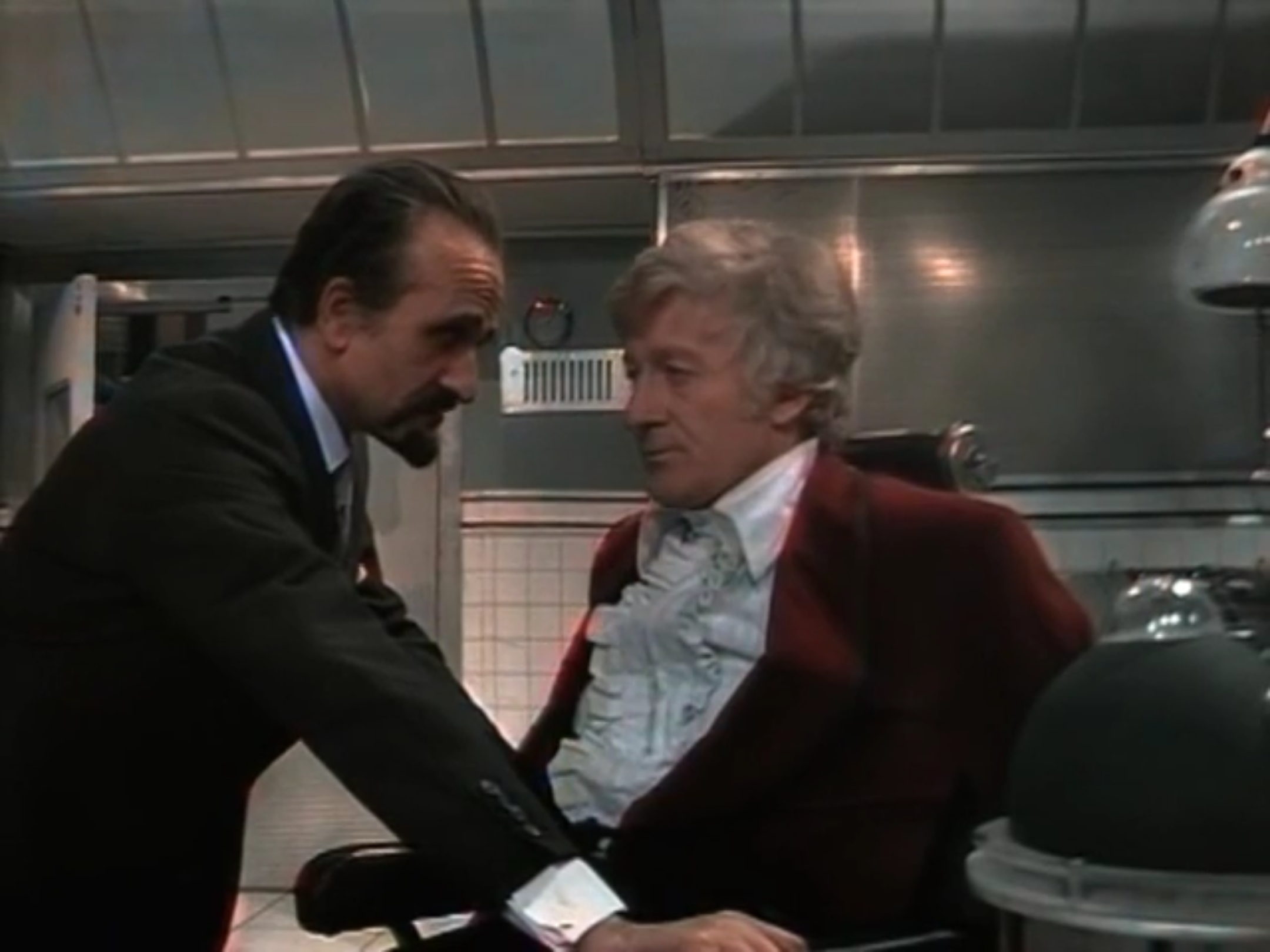
A standoff between the Doctor and the Master.
The latest standoff between the Doctor and the Master.

6 episodes. Running Time: Approx. 144 minutes. Written by: Malcolm Hulke. Directed by: Paul Bernard. Produced by: Barry Letts.


THE PLOT:

The empires of Earth and Draconia stand at the brink of war. Each side's ships have been raided, with survivors swearing that the other side is responsible. So far, Earth's President (Vera Fusek) and Draconia's emperor (John Woodnutt) have been able to maintain the peace, but calls for action among both races are growing.

This hostile environment is what awaits the Doctor and Jo when the TARDIS materializes inside an Earth cargo ship. When the ship is attacked, the members of the crew see their attackers as Draconians, even though the raiders are actually Ogrons. The Ogrons knock the crew unconscious and steal the TARDIS. When the Doctor attempts to tell the authorities what happened, he and Jo are arrested, charged with being spies working for the Draconians!

The Doctor soon realizes what is happening: A third party is using technology to trigger a fear response among the crews. Someone is trying to start a war. But no one in authority, either among the humans or the Draconians, is willing to believe him. Seemingly every conversation just leads the Doctor and Jo to a new interrogation, accusation, or prison.

Eventually, they are remanded to the custody of a colony offical - The Master! He is in command of the Ogrons, who are following his plan to destabilize the galaxy's two great powers. There's one more complication: The Master isn't working alone...


CHARACTERS:

The Doctor: He retains a cool head throughout. In Part Two, when he and Jo are being held in the freighter's cell, she keeps trying to plan an escape so that they can get back to Earth. He points out that the ship is already on the way to Earth and that the people who will interrogate them are the very people they need to speak to. He initially hopes to get either the President or the Draconians to believe him. By the second half of the story, he unhappily resigns himself to the reality that no one will believe him unless he can provide proof, but he remains determined to find a way to prevent war.

Jo Grant: Most of her best moments in this story involve the Master. There's a scene in which the Doctor escapes from a cell under surveillance. Jo plants herself between the eye of the camera and the Doctor and essentially filibusters, rambling from topic to topic to keep their adversary from realizing that the Doctor has gone. Later, she resists an attempt by the Master to hypnotize her (again), and she holds firm against his fear device. He may be able to make her see monsters such as Sea Devils and Drashigs, but she rejects each illusion in turn, shouting back that "it's not real!"

The Master: This was Roger Delgado's final story as the Master; and though it wasn't planned as such, it turns out to be a fine showcase for the character. The Master's plan is genuinely clever, aggravating existing tensions and then mostly leaving the humans and Draconians to do his work for him. After a slightly "off" showing in The Time Monster, Delgado is back in top form here, the picture of urbane charm as he plays all sides against each other.

Ogrons: They were introduced the previous season as the Daleks' mindless henchmen. This serial clarifies that they are mercenaries who will work for anyone who pays. They're still not terribly interesting creations, being "dumb muscle" and not much else. It's not hard to see why they didn't catch on past the Pertwee era, and I'm legitimately confused as to their popularity in Doctor Who books and audios. They're better here than in Day of the Daleks, though, mainly thanks to the Master's clear impatience with their stupidity.

Draconians: Unlike the Ogrons, they are interesting, their society structured around strict codes. They are formal in speech and manner, and they abhor direct lies - though as the Draconian ambassador's actions show, they are not above deception as long as they can make it work within that framework. The design is particularly good, the makeup elaborate enough to be convincingly alien while still leaving the actors' faces free for a full range of expressions. Given how well they work in terms of both writing and makeup, I'm surprised that this was their only television appearance.


THOUGHTS:

Frontier in Space benefits from some good world building. This starts from the very first scene. The two crew members on the freighter discuss the potential of war with the Draconians. It's your basic exposition exchange, but it's given a lift by the attitude of the older crew member, who shrugs the whole thing off: "They steal a few of our cargoes, we steal a few of theirs. It'll all blow over."

A lot of information is sketched in quickly. Both sides still bitterly resent a previous war, one that we eventually learn was based on a misunderstanding (one that so closely mirrors the origins of Babylon 5's Earth/Minbari war that I can't help but wonder if J. Michael Straczynski had seen this story). The human government is at least somewhat authoritarian, with political dissidents sent to a prison from which no one returns. The Earth President has a lot of authority when it comes to questioning the Doctor and Jo or maintaining/severing diplomatic relations with the Draconians, but she cannot dictate purely military matters. These sorts of details help to make this future seem more real than many of Doctor Who's future societies.

Hulke was always good at weaving substance into his stories, and this is no exception. The Master is deliberately playing on the tensions between the two empires, but he didn't create them. His plan relies on fear. The humans fear the Draconians, and the Draconians fear them. With a slight push from his hypnotic device, he is able to use their existing fear to push both sides to make bad decisions and to take increasingly rash actions. It is, to put it mildly, not difficult to find real world instances of calamitous decisions that were driven by fear.

Structurally, there are good and bad elements. The narrative keeps itself fresh with frequent shifts of focus. The first two episodes revolve around the Doctor's and Jo's (unsuccessful) attempts to convince the Earth and Draconian authorities of the truth. The next two introduce the Master and his role in creating the current crisis, while also making time for an entertaining prison break caper. The final two episodes shift again, with the Doctor finally finding allies as the story reaches its conclusion. The regular changes in setting and focus keep the six episodes from becoming too stale.

Some staleness happens, however, because this serial suffers from severe repetition. In Episode One, the Doctor and Jo are captured and put in a cell. They escape, only to be recaptured and put back in that cell. In Episode Two, they are put in a cell on Earth. The Draconians break the Doctor out and briefly hold him captive, until he escapes and is recaptured by the humans. This continues for the entire story, with the Doctor and Jo being basically passed from one group to the next and from one cell to the next. There is simply too much of this, and the capture/escape pattern becomes tiresome long before the end.

Performances are strong. Pertwee is at his most authoritative when dealing with the various officials. He remains generally calm throughout, but we can see the Doctor growing more frustrated as the story goes along. He and Katy Manning continue to play wonderfully off each other, granting added energy to their scenes together, and Roger Delgado is excellent opposite both of them.

Oh, and if you haven't seen this serial yet... AVOID SPOILERS! There's a terrific twist late in the story, one that few viewers would be likely to see coming even though the story lays all the necessary groundwork. If you somehow don't already have prior knowledge of it, then don't look up anything about this serial before watching it.


OVERALL:

There's a lot to enjoy in Frontier in Space, from the interactions among the characters to the efficient world building. It does suffer from too many repetitions of the capture/escape formula, though, and this is definitely one of those stories best viewed an episode at a time rather than all in one sitting.

It's enjoyable thanks to strong performances and a fast pace, and it gets an extra boost from a late plot turn. Still, I think the repetitive structure keeps it from being as good as it might have been.


Overall Rating: 7/10.

Previous Story: Carnival of Monsters
Next Story: Planet of the Daleks

Review Index

To receive new review updates, follow me:

On BlueSky:

On Threads:

Sunday, August 25, 2024

#14 (9.21 - 9.26): The Time Monster.

The Doctor, Jo, and the Brigadier are pitted against the Master. Again.
The Doctor, Jo, and the Brigadier are
pitted against the Master. Again.

6 episodes. Running Time: Approx. 147 minutes. Written by: Robert Sloman, Barry Letts (uncredited). Directed by: Paul Bernard. Produced by: Barry Letts.


THE PLOT:

The Master is passing himself off as "Professor Thascalos" in order to run experiments at the Newton Institute, located near Cambridge. Using his TARDIS as a power source, and with the aid of the unwitting Dr. Ruth Ingram (Wanda Moore) and her assistant Stuart (Ian Collier), he attempts to summon Kronos, the most powerful of the Chronovores, time creatures who were once worshipped as gods. With Kronos's power, the Master intends to control the universe!

The power from his experiments draws the attention of the Doctor and UNIT. The Doctor tries first to separate the Master from his TARDIS, then engages in tactics meant to delay him. In the end, though, he will have to chase the Master into the ancient past, to the lost civilization of Atlantis - where the Master has already found an ally...


CHARACTERS:

The Doctor: Spends much of the first four episodes fidgeting with gadgets and spouting Technobabble. Fortunately, Jon Pertwee is back on form, his authority and charisma giving a significant lift to what might have been dry material. He also gets a particularly good scene in the final episode. As he and Jo await execution, he reminisces about a day in his youth when he decided that life was pointless, only to have an old man point out "the daisyest daisy (he'd) ever seen." It's a lovely monologue, very well performed by Pertwee.

Jo Grant: Though the Doctor's assistant, she seems to also regard herself as his protector. She insists on accompanying him to Atlantis even when he points out the danger, insisting that it's her job to help him. When the Master seems to have defeated him, she announces that she doesn't care what he does to her.

Brigadier Lethbridge-Stewart: After a pompous official starts talking about conducting an official inquiry, using that to berate a Cambridge professor, the Brigadier intercedes by declaring the exact law, subsection, and paragraph to compel secrecy. He quickly shuts the official down, and it's clear that the Brig enjoys using his position to squash a bully. Later, when Capt. Yates is endangered, he tries calling for Yates on the radio. When he gets particularly worried (in time for the cliffhanger), he switches from calling him "Captain Yates" to "Mike."

Sgt. Benton: While he's guarding the lab, the Master attempts to lure Benton away by impersonating the Brigadier's voice. The sergeant isn't fooled, using the opportunity to set a trap. It fails, of course, or the story would only be two episodes long, but it shows resourcefulness on his part.

Dr. Ruth Ingram: As the scientist who has assisted "Professor Thascalos" (The Master) with his experiments, actress Wanda Moore has the most prominent guest role for the first four episodes. Sadly, she also gets saddled with a lot of annoying "battle-of-the-sexes" dialogue. She talks about how spineless or patronizing the men around her are - then patronizingly tells Benton to "stand there and look pretty." I'm fairly certain the point was to show male viewers how annoying sexism is by reversing it... but it mostly comes across as forced, and I suspect it did in 1972 as well.

Queen Galleia: Ingrid Pitt, a regular fixture of British horror films of this period, appears in the final two episodes as the queen of Atlantis. She is instantly smitten with The Master, recognizing him as a man who will do anything to achieve power, and she begins plotting with him against her husband, King Dalios (George Cormack). This might have made for an engaging bit of court intrigue, had the serial reached this point at least one episode sooner. As it stands, the entire subplot is rushed, with Galleia's coup occurring offscreen. Still, at least Pitt acts her lines instead of shouting them, which helps her to stand out from most of the other actors in the Atlantis segment.

The Master: Speaking of shouting... This is almost certainly Roger Delgado's weakest performance as The Master. He spends the first two episodes adopting a wildly inconsistent accent while pretending to be a foreign professor. He then spends much of the back half of the story shouting most of his lines. Given how many of the guest cast also adopt this style, I wonder if this was less a case of Delgado having an "off" day and more a case of questionable directing choices.


THOUGHTS:

The Time Monster has not generally been well-regarded. I actually enjoy the story, but I'll admit that there's a lot to criticize.

The story is focused on Atlantis, but the Doctor and the Master spend four episodes marking time in a present-day lab before they manage to get there. When they finally arrive, the Atlantis sets are tacky even by Classic Who standards. Between the costumes and the stagey/shouty performances, I had the distinct impression that I was watching a Greek myth as staged by an underfunded community theatre.

With most of the actual plot reserved for the final episodes, the first four parts consist of... well, padding. A lot of padding. The Doctor turns down the chance to observe the demonstration in order to follow his device that goes "bing," which leads him and Jo to... um, the exact demonstration he decided not to go to. He spends a big chunk of Episode Three building a thing to delay the Master. When he finally succeeds, it causes a delay that lasts... maybe as much as thirty seconds.

Other bits are actually a lot of fun. Characters are aged and de-aged. Others get stuck in time, running slowly in place until they just plain stop. The Master brings soldiers from the past to delay UNIT. The Doctor and the Master find their TARDISes fused, each materialized inside the other.

None of these set pieces do anything to advance the story, but they are amusing and clever. I just finished watching and already barely remember the Atlantis/Kronos plot. But I recalled the TARDIS-in-a-TARDIS and "soldiers plucked out of time" moments from my last viewing of the story, even though that was a good two decades ago!


OVERALL:

At six episodes, The Time Monster is too long for its rather thin narrative. It's also bizarrely structured so that almost all of the story is packed into the final two episodes, leaving the rest extremely padded even by '70s Who standards. It also features guest performances that are uneven at best - and sadly, I include the usually excellent Roger Delgado in that assessment.

What saves it, for me at least, is that a fair amount of the padding is fun. The various time tricks the Doctor and Master pull on each other are often enjoyable to watch, showing a scene-by-scene inventiveness that keeps the whole thing alive. The two worst episodes end up being the last two - the two where the story finally happens.

In the end, while I can't call this a good story, I would call it a fun one. Within this same season, The Curse of Peladon is "better" - but I was more entertained by this.


Overall Rating: 6/10.

Previous Story: The Mutants
Next Story: The Three Doctors

Review Index

To receive new review updates, follow me:

On BlueSky:

On Threads:

Sunday, August 11, 2024

#12 (9.09 - 9.14): The Sea Devils.

The Master forges an alliance.

6 episodes. Running Time: Approx. 148 minutes. Written by: Malcolm Hulke. Directed by: Michael E. Briant. Produced by: Barry Letts.


THE PLOT:

Ships are vanishing at sea, all in a very specific area near a sea fortress being renovated by the Royal Navy. This is not on the Doctor's radar at all... until he and Jo visit the Master at his heavily fortified island prison, where the warden, Col. Trenchard (Clive Morton), makes an offhand mention.

The Doctor investigates, leading him to discover aquatic lifeforms that he recognizes as relatives of the Silurians. Like the Silurians, these "Sea Devils" have awakened to find the planet that was once theirs now belongs to man - and they want it back.

As before, the Doctor hopes to find a peaceful solution. But first he'll have to deal with the Master, who is planning to use this situation for his own benefit. But the Doctor's efforts are complicated when he realizes that his old enemy has taken full control of his prison, with Trenchard and all the guards now working for him!


CHARACTERS:

The Doctor: His trust in Jo has grown over time. When she says she's seen the Master at the Naval Base, he doesn't waste a second doubting her. He snaps at Capt. Hart (Edwin Richfield), the ranking officer, to lock the place down immediately. Jon Pertwee is on particularly good form throughout this story. While visiting the Master, the Doctor tries to coax him into revealing the location of his TARDIS. The Master refuses; and Pertwee shows the Doctor's reaction in his frosty delivery of, "Ask a silly question," before returning to his normal affability. Another good moment sees him bribing the boatman into running an errand that will allow him to borrow the man's vessel. He says he would run the errand himself, except that his bad leg is acting up. He runs through a couple historical battle sites ("Crimea... Gallipolli? El Alamein?"). Then he gives up and just smiles, holding up the cash and saying, "Does it really matter?" 

Jo Grant: I liked the Doctor/Jo relationship in Season Eight; in Season Nine, to repeat an observation I made about the previous story, the two of them positively sparkle. When Jo helps him to escape a trap set by the Master, they take turns beckoning the other to leave through the open door, exchanging "After you; no, after you" in a bit that feels unscripted (whether it was or not) in the best way possible. One minus, however: There are two scenes in which Jo is written to physically attack guards. In both cases, it looks hilariously unconvincing. I love Jo when she's interacting with the Doctor, or when she has flashes of ingenuity... but let's not try to make her into Emma Peel, because that really doesn't work.

The Master: Imprisonment has done nothing to make him less dangerous. He takes the measure of his captors, manipulating them to turn strengths into weaknesses that can be preyed upon. He does this with Trenchard in the first half of the story, then repeats the same feat with the Sea Devils. Roger Delgado is at his most charming, and his interactions with Pertwee are some of their best. He may want to take revenge on the Doctor for his captivity, but he doesn't underestimate him. When he discovers that Trenchard let slip about the missing ships, he is enraged, and he isn't at all mollified when Trenchard says that the Doctor didn't seem interested. He knows his adversary too well to think that he won't investigate such a mystery.

Pompous Bureaucrat of the Week: Trenchard, the warden of the Master's prison, is a man whose career is mostly behind him. He was once governor of a British colony - but only for long enough to grant the colony its independence. No resentment is ever stated, but it's not hard to imagine his frustration at having his career apex snatched away, only for him to be treated as a silly old man and/or a nuisance thereafter. This makes him easy prey for the Master, who manipulates him with visions of being a hero.

Pompous Bureaucrat #2: Trenchard is basically a good man who has been led astray. The same cannot be said of this story's other bureaucrat, Parliamentary Secretary Walker (Martin Boddey). Walker arrives late in the story, introducing himself by being dismissive and sexist toward both Jo and a female naval officer, whom he treats as a glorified secretary. It only gets worse from there. He preens behind his desk, stuffing his face while gleefully ordering an attack. Later, in a position of weakness, he turns into such a coward that I think even The Claws of Axos's loathsome Mr. Chinn would look down on him in contempt.

Sea Devils: The oceanic cousins of the Silurians. Their design is impressive by Classic Who standards, with their amphibian qualities making them look correct as ocean dwellers and their cold eyes and stature making them threatening. Unfortunately, this story is more concerned with the Master than with them, so they are mainly relegated to the role of "monsters," though their leader at least briefly considers the Doctor's appeals for peace.


THOUGHTS:

The Sea Devils was Season 9's big production, with location filming, reasonably large-scale action scenes, a decent-sized guest cast, and cooperation by the Royal Navy lending significant production value. Aside from a submarine set that's unconvincing even by 1970s TV standards, this is a rare "Classic Who" story that looks good.

Malcolm Hulke's script juggles the different elements well. Though the Master is the main villain, the Sea Devils are established as a presence early, with their activities having drawn the attention of the Navy, the Doctor, and the Master all. The different threads all feed each other narratively. The Doctor sees the Sea Devils; though Capt. Hart (Edwin Richfield) is skeptical, he sends a submarine to investigate, and that submarine plays into the story in its late episodes. The Master spends much of Episode Three building a device, and the construction of a larger version becomes a key part of Episode Six. All the pieces end up fitting together.

The serial is mainly an action piece, and as such it feels less weighty to me than Season Seven's Dr. Who & the Silurians did. The design of the Sea Devils is superior to that of the Silurians; but as they are secondary villains in their own story, they just aren't as interesting on the page. The different Silurians in the earlier story had individual personalities and motivations. The Sea Devils are basically just monsters, with the Doctor's peace overtures feeling more like a token effort than like the increasingly desperate driving force of the earlier story. Unusually for a Malcolm Hulke story, the script makes theme subordinate to incident.

But it's hard to complain when so much of the incident is so entertaining. The Doctor and the Master get into a sword fight, with the Doctor getting the upper hand... and pausing mid-fight to munch on a sandwich. A Sea Devil rises from the water onto the beach where the Doctor and Jo are escaping, forcing them into a minefield. The Doctor descends in a diving bell; when the bell is brought up, he has vanished, with Jo climbing in and staring wide-eyed at the empty chamber. The overall excellent realization and sure-handed direction by Michael E. Briant helps each moment and visual to land that little bit harder.

My only real complaint is with Malcolm Clarke's music. His experimental score is deliberately intrusive. This is effective when the Doctor and Jo investigate an empty facility that has been attacked by Sea Devils, or in scenes that see the Sea Devils attacking or about to attack. In other moments, however, it's just distracting, with the shrill noises particularly detracting from the well-choreographed Doctor/Master swordfight. To the sound editors: We do not need to hear the score "bleep" at us every time their swords touch, thank you.


OVERALL:

I could wish for a bit more of a sense of personality from the Sea Devils themselves, and I don't think this story makes the impact that Dr. Who & the Silurians did. On its own terms, however, The Sea Devils is a well-made and engrossing action/adventure story. Pertwee, Manning, and Delgado are at their best, the script is efficiently structured, and it's among the best-looking stories of all of "Classic Who."

It's very much a set piece story, and I think it benefits from being watched one episode at a time over multiple sittings instead of all at once. But it's a really good set piece story, and it's probably among the serials that would be most accessible to modern viewers.


Overall Rating: 9/10.

Previous Story: The Curse of Peladon
Next Story: The Mutants

Review Index

To receive new review updates, follow me:

On BlueSky:

On Threads:

Thursday, November 9, 2023

#9 (8.21 - 8.25): The Daemons.

The Master takes control of a Satanic cult.

5 episodes. Running Time: Approx. 122 minutes. Written by: Guy Leopold (pseudonym for Barry Letts and Robert Sloman). Directed by: Christopher Barry. Produced by: Barry Letts.


THE PLOT:

Professor Horner (Robin Wentworth) is conducting an archaeological dig of the "Devil's Hump," an ancient burial mound located by the village of Devil's End. The Doctor watches the coverage on the BBC. After the superstitious Miss Hawthorne (Damaris Hayman) is shown berating the professor that his dig will bring disaster on them all, the Doctor declares that she's right and insists that he and Jo drive up to Devil's End immediately!

He's too late to stop the dig, arriving just as the professor breaks through. The icy gust that emerges from kills the professor, but the Doctor is saved by his ever-useful Time Lord metabolism. Capt. Yates and Sgt. Benton join the two of them in the village; but before the Brigadier can arrive, an invisible dome of heat cuts Devil's End off from the rest of the world!

Though Miss Hawthorne insists that this is the work of the devil, the Doctor is certain there is a more scientific explanation. He becomes even more convinced when he learns of the new vicar in town: the Reverend Magister... the Master!


CHARACTERS:

The Doctor: He's particularly irritable in this story. This is likely because he already knows what the threat is and how serious it is, and so every delay or setback aggravates him that much more. It is worth noting that when Jo mimics his condescending attitude toward the Brigadier, he immediately upbraids her for it. He does have basic respect for Lethbridge-Stewart; he may butt heads with and even insult him, but he won't stand by while anyone else does the same.

Jo Grant: This is a particularly strong story for Jo. When she and the Doctor arrive in Devil's End, he pointlessly alienates some villagers at a local pub while trying to get directions to the dig. Jo steps in to mediate, which by this point she does pretty much on instinct. Predictably, she gets better results with a warm tone and a smile than the Doctor manages. When he's injured at the dig, she watches over him like a mother hen. She also plays a key role in the story's resolution.

The Master: In a story that borrows heavily from horror movie tropes, the Master assumes the guise of a devil worshipping priest. He gets a particularly plum scene in Episode Three. At a gathering of villagers, he calls out the townsfolk by name and recites their sins, from the petty (a grocer padding the bills of wealthy customers) to the severe (murder), all without judgment and even with a hint of approval. A silver tongue only goes so far, however; when one man protests too much, he calls on his Right-Hand-Gargoyle to do away with the troublemaker. Roger Delgado has been terrific all season, but I think this performance is his series best.

Brigadier Lethbridge-Stewart: Spends the bulk of the story locked out of the town, stuck on the opposite side of the heat barrier. When he finally arrives, he calmly takes in the devil worshippers and the unkillable living gargoyles and delivers his iconic order: "Chap with the wings there: Five rounds rapid." Me, I prefer his closing line. When all the other characters are joining a village dance, he expresses his preference for going to the pub for a pint.

Capt. Yates: He and Jo may not be dating, precisely, but it's clear there's a strong mutual attraction. At the start, the two of them have plans to watch the dig on television together - a date the Doctor crashes when the name "Devil's End" catches his attention. It's after Jo calls him from the village that he commandeers the Brigadier's helicopter; and when he states the need to check on the Doctor and Jo as the top priority, his specific phrasing is "Jo and the Doc" - with Jo at the top of his mind.

Sgt. Benton: He has his own priority when they arrive at the village: breakfast. Yes, Benton truly is the most relatable member of UNIT. He rescues Miss Hawthorne from the Master, and is pronounced her "knight" as a result. His keen marksmanship also allows the Doctor to put on an impromptu - and life saving - magic show near the story's end.


THOUGHTS:

The Daemons is a fan favorite, and it's easy to see why. While there are still a few of the classic series' trademark "very special" effects (such as almost anything to do with the "Daemon" of the title), the overall production values are pretty high. Much of the story was shot on location at the village of Aldbourne, which helps it to break free of the studio look of many serials.

I have complained in the past about finding director Christopher Barry's work for the series to be a bit stagy. Given this, I think it only fair to give him props for a largely terrific job here. He follows the cues in the script and captures the spirit of many British horror films of the period. The combination of the supernatural atmosphere with the script's themes of science vs. superstition proves effective - as would be true when producer Philip Hinchcliffe would regularly mine that vein a few years later.

There's a lot to praise in this story. It's well-paced. Its script is witty and often quotable. Its five episodes are consistently engaging. But the thing I most noticed was how well this serial uses Season Eight's full ensemble.

Every regular character gets something to do. The Master, who felt tacked onto The Colony in Space, is at his best here. With that beard and aristocratic bearing, it seems only natural for him to be conducting Satanic rituals, while spending many of his scenes dressed up as a priest. Nicholas Courtney gets some great lines as the Brigadier fumes impatiently on the wrong side of the barrier; and his sidelining for most of the story allows Benton and Yates to enjoy a greater share of the spotlight. Not to mention Jo, who arguably is even more the hero of this story than the Doctor!

Simply put: Everyone gets a page, and this is accomplished without bogging things down.


OVERALL:

The Daemons is a rare case of Classic Who delivering a "modern" season finale. Season Eight was "The Master Season," with the stories centered around him making mischief, mostly on Earth. This season brings that to an appropriate close, and it does so while giving Roger Delgado's Master his best role of the season.

Most importantly, though, this is a good, fun romp that easily justifies its reputation as a fan favorite.


Overall Rating: 9/10.

Previous Story: The Colony in Space
Next Story: Day of the Daleks

Review Index

To receive new review updates, follow me:

On BlueSky:

On Threads:

Friday, September 15, 2023

#8 (8.15 - 8.20): The Colony in Space.

The Doctor and Jo study the history of a once-great, now primitive civilization.
The Doctor and Jo study the history of a
once-great, now primitive civilization.

6 episodes. Running Time: Approx. 145 minutes. Written by: Malcolm Hulke. Directed by: Michael E. Briant. Produced by: Barry Letts.


THE PLOT:

The Doctor has completed repairs on his dematerialization circuit. He installs it while showing off the TARDIS control room to Jo. Then, suddenly, the timeship takes off on its own!

They materialize on Uxarieus, a desolate world whose only indigenous life is a civilization that has devolved into a tribal, primitive state. A group of humans, fleeing overpopulation on Earth, is attempting to build a colony here. Ashe (John Ringham), their leader, reveals that they have begun running into problems: crops that fail without cause and sightings of giant lizard creatures. Many of the colonists are on the verge of giving up and going back to Earth.

That's when representatives of the Interplanetary Mining Corporation show up. Led by Captain Dent (Morris Perry), the IMC men insist they were surprised to find a colony here. Soon enough, the Doctor discovers that the colony's problems stem from sabotage by IMC, with Dent determined to drive them out so that he can strip-mine the planet.

The colonists send for an Adjudicator to resolve the dispute. But the man who arrives, for all his credentials, is an imposter. The Doctor and Jo recognize him immediately: It's the Master - and he has come to this barren world for reasons all his own!


CHARACTERS:

The Doctor: When he shows off the TARDIS to Jo, he preens at her amazement that "it's bigger on the inside." As soon as they take off, he realizes that the Time Lords must be controlling his ship. Even so, he's happy to step out onto a planet that isn't Earth again. He badly wants Jo to share in his delight at even this temporary escape, seeming to almost need her to feel the sense of wonder.

Jo Grant: She reacts to the TARDIS's sudden takeoff the way most people would: with fear and a desire to go back home. She trusts the Doctor, and she allows him to coax her out onto her first alien world. She seems to pass an unspoken test when she forgets her anxiety long enough to be dazzled by an alien flower - but that doesn't stop her from being appalled when the TARDIS is stolen. This nervous reaction is well written, and it helps her to remain relatable. Crucially, her fear doesn't come at the expense of her helping the colonists. She bonds with them quickly and is actively assisting with daily chores by the second episode.

The Master: This is the one Season Eight story where his appearance feels tacked on. Still, Roger Delgado's performance remains excellent, and the script feeds him a few good character beats. He's learned caution from the Doctor's previous burglary of his TARDIS, putting in an alarm and additional defensive measures. He's also entirely genuine in wanting the Doctor to join him in his scheme, and he's hurt by his rival's rejection.

Brigadier Lethbridge-Stewart: Nicholas Courtney appears just long enough to justify his spot in the credits. Even that couple of minutes establishes that he's actively following up on leads regarding the Master's whereabouts. The Doctor insists that this is a waste of time, but I'm going to side with the Brig on this. It's already clear that the Master has a desire to defeat the Doctor, not just escape him, so it's reasonable to think that he'll turn up on Earth again at some point.

Capt. Dent: The story's actual main villain. Morris Perry leans hard into the character's archness, just in case you miss that he's evil... Not that you're going to, because this is a man with zero positive traits. He's utterly corrupt and obsessed with profits. His plan is to scare the colonists away, but he is unbothered when an encounter results in two deaths. He wants to cover his worst abuses legally, even holding a show trial for the colony leaders at one point. The only thing that ultimately matters, however, is that he clears them out so that he and his men can mine the planet's resources.


THOUGHTS:

The Colony in Space is the first story of the Pertwee era to break the Earthbound/UNIT format. Though I've enjoyed that format, it was time for a change of pace. The simple fact that the Doctor goes back to traveling for a story, albeit on a leash, makes for a refreshing change of pace.

This story is not generally regarded as one of the era's better ones, but I've always rather enjoyed it. The first four episodes work particularly well. The conflict between the colonists and the miners may be routine stuff, but it's deftly scripted and builds steadily, an accumulation of incidents that leads to rising violence.

There are a range of personalities on both sides. Ashe, the colony's leader, is patient to a fault and wants to find peaceful solutions using the law. His second-in-command, Winton (Nicholas Pennell), is quick to want to fight, with both Ashe and the Doctor trying to hold him back. But given how aggressive the IMC men are, Winton may just have a point regarding the need for self-defense! Meanwhile, though the miners are definitely the "baddies," mining expert Caldwell (Bernard Kay) despises the methods that Dent is willing to use - and even Dent occasionally has to check the open sadism of security man Morgan (Tony Caunter).

I find the final two episodes to be a lot weaker, and I can describe why in two words: The Master. Roger Delgado is as good as ever, but he doesn't feel like an intrinsic part of the plot. It takes more than half the serial for him to appear, and he spends all of Episode Four pretending to be an Earth official and acting in that capacity. It would not surprise me if this had been originally scripted as a Master-free serial, with his subplot tacked on.

The final episode particularly feels as if it's cutting between two unrelated narratives, one involving the colony and one involving the Master. This harms both threads: The Master story feels rushed and underdeveloped, and the ending of what had been the serial's central plot gets squeezed around the Master's latest shenanigans.


OVERALL:

The Master subplot harms the ending, but not enough to stop me from recommending the story overall. For the bulk of its running time, The Colony in Space is enjoyable bread-and-butter Who, and even the final episodes offer several good moments. Most of all, when viewing the series in order, it's a breath of fresh air to see the Doctor get away from Earth, if only for one story.

I just wish that this one time, the Master had been left out of the proceedings.


Overall Rating: 6/10.

Previous Story: The Claws of Axos
Next Story: The Daemons

Review Index

To receive new review updates, follow me:

On BlueSky:

On Threads:

Sunday, August 6, 2023

#7 (8.11 - 8.14): The Claws of Axos.

The Axons come to Earth, bearing gifts...

4 episodes. Running Time: Approx. 97 minutes. Written by: Bob Baker, Dave Martin. Directed by: Michael Ferguson. Produced by: Barry Letts.


THE PLOT:

When an alien spaceship lands near a nuclear power plant, UNIT scrambles to contain the area. They receive a distress call from the ship, identifying it as Axos and begging for immediate assistance. The Doctor, Brigadier Lethbridge-Stewart, and ministry official Horatio Chinn (Peter Bathurst) enter the ship and encounter the Axons.

The Axons offer a simple exchange. If the humans allow them to stay long enough to replenish their fuel supplies, then they will share Axonite, a "thinking molecule" that will greatly expand whatever it is applied to. It can alleviate the world's hunger problems, providing unlimited food - and, as both the Doctor and Chinn recognize with sharply different reactions, also unlimited power.

Suspicious of this gift, the Doctor attempts to study the molecule. Meanwhile, the Axons strike a deal with a prisoner they seized in deep space. This man offered them the planet Earth, and he is more than willing to help them to destroy all life in exchange for his freedom. The Master has come for his revenge...


CHARACTERS:

The Doctor: He disdains Chinn's initial "shoot first, think later" approach to the Axons' arrival, and he feels vindicated when the aliens' distress call is received. Even so, he does not blindly accept their word. Even as Chinn salivates over the power Axonite promises, the Doctor starts poking holes in the aliens' story, asking how they could possibly have had a fuel problem with such a miracle molecule on board. The final episode sees him forced into an alliance with the Master, whereupon he feigns a selfishness to match the Master's own. Pertwee plays these scenes of a petty, self-interested Doctor particularly well, and there's a sense that the Doctor is giving voice to legitimate frustrations with both the humans and the Time Lords who exiled him.

The Master: With the final episode seeing the Third Doctor playing at being a baddie, it's only fair that Roger Delgado's Master gets a moment to play hero. The back half of Episode Three puts him in the Doctor's usual role, forging an alliance with the Brigadier to stop the Axons. It's like a glimpse of an alternate reality where Delgado was cast as the Doctor, and he fills the role well, with authority, intelligence, and no small amount of snark. The story as a whole shows a different side to the character. Instead of being in control, he is a prisoner, trying to scheme his way back to freedom. As a result, even though it's the third Master story in a row, his presence has yet to start feeling repetitive.

Jo Grant: When the Doctor and the Brigadier first enter the Axon ship, they both tell Jo to stay behind. She agrees... only to almost immediately follow them. When she hears cries for help inside the ship, the Axons claim that it's an auditory hallucination. She is upset when the Doctor seems to accept this, and genuinely relieved when the Doctor later tells her that he believed her but didn't want the Axons to know that he did. Her absolute faith in the Doctor is evident in the final episode, when she dismisses even the thought that he might have turned on UNIT.

Brigadier Lethbridge-Stewart: He instantly takes the measure of ministry official Chinn, and he treats him with almost as little patience as the Doctor does. He reacts to Chinn as a minor annoyance, even making him leave the UNIT operations room to use a telephone. Even so, when crisis hits, he puts the politics aside to focus on the more important matter. Though he's reluctant to make any deal with the Master, he bows to the inevitable when the situation becomes hopeless - though he remains wary even after making the agreement.

Pompous Bureaucrat of the Week: Horatio Chinn (Peter Bathurst) is so idiotically, counterproductively self-important that there must be a life sized brass-and-turpentine plated statue of him in the Idiot Bureaucrats' Hall of Fame. His communications with his superiors make it clear that he is poorly regarded within the ministry, with his job hanging by a thread. Chinn is given all the authority he requests - but it's a case of him being given the rope to hang himself, with it made explicit that he will take the fall if (and when) things go wrong.


THOUGHTS:

The Claws of Axos is about as close to a live action comic book as Doctor Who ever got. It's a particularly colorful story, from the Axons' ship to the aliens' outfits to even the monsters. Scenes are short, the action cutting back and forth with the regularity of comic panels. One can almost see the "Whoosh!" that would be added as the Master jumps onto the back of a UNIT truck, while Mr. Chinn is so over-the-top that it's impossible to take him seriously. It all adds up to a story with a decidedly campy, old style comic book tone.

This was the first story from Bob Baker and Dave Martin, who would be regular writers for Doctor Who throughout the rest of the 1970s. It is fair to say that I find them to be hit-and-miss. For every story of theirs that I like, there's another that's... well, haphazard at best. But their debut effort is consistently enjoyable, while at the same time spotlighting their strengths as writers and some of their weaknesses.

A consistent Baker/Martin strength is imagination, and that is evident. While the Axons' plot against Earth isn't anything unusual for the series, their nature is: the ship is organic, grown not built, with the Axons actually a part of their own vessel.

Also evident, however, is the duo's lack of discipline. After scheming against Earth for more than half the story, the Axons suddenly switch goals midway through Episode Three to demanding the secrets of time travel from the Doctor... something they could already have gotten from the Master, who has been their prisoner for an undisclosed period of time. The subplot with Chinn gets a lot of screen time in the story's first half... only for the character to be demoted to "glorified extra" in the second half, his subplot vanishing all but entirely after a last telephone call with the ministry. Also, one of the most enjoyable story beats is the Master's partnership with UNIT at the end of Episode Three. This is a fun change-up that should have been reached sooner and held longer.

All of that acknowledged, The Claws of Axos is never dull, something that can't be said of many stories that I'd otherwise rank as much better. The pace is fast, with short scenes that cut in, get to the point, and move on. The regular cast is well used. Finally, though the tone may be silly and over-the-top, this does not come at the expense of the main characters. Both the Brigadier and his team remain competent throughout, and the Doctor is treating the situation with absolute seriousness.

Finally, while the limited budget shows (two words: shower curtains), I'm a big fan of the set design for the Axos. I won't say it looks convincing, but the production does its job of giving the ship an organic look that matches the cues of the script, along with a brightly colorful aesthetic that matches the comic book sensibilities.


OVERALL:

The Claws of Axos is not a great story. It lacks the layered themes of Dr. Who & the Silurians, the meticulous structure of Inferno, or the urgency of either of those titles. But sometimes you don't want a "great" story; sometimes you just want to turn your brain off and enjoy the ride.

On that level, The Claws of Axos is a success. It may be silly, but it's also fast and colorful. It will never crack my Who Top Ten, or even my Top Twenty... but that it will ever fail to entertain me.


Overall Rating: 7/10.

Previous Story: The Mind of Evil
Next Story: The Colony in Space

Review Index

To receive new review updates, follow me:

On BlueSky:

On Threads:

Sunday, June 18, 2023

#6 (8.5 - 8.10): The Mind of Evil.

The Master pressures the Doctor into helping him control the dangerous Keller Machine.
The Master pressures the Doctor into helping
him control the dangerous Keller Machine.

6 episodes. Running Time: Approx. 147 minutes. Written by: Don Houghton. Directed by: Timothy Combe. Produced by: Barry Letts.


THE PLOT:

UNIT is handling security for a World Peace Conference being held (of course) in London. Everything is running smoothly - until the Chinese delegate is murdered. Brigadier Lethbride-Stewart suspects Chinese Captain Chin Lee (Pik-Sen Lim), whose account of the incident has glaring holes in it. As incidents mount, he demands the Doctor report to him at once.

The Doctor is pursuing his own concern: The Keller Machine at Stangmoor Prison. The machine has been presented as a new method of treating criminals by removing all negative impulses from the mind. The Doctor already sees this as dangerous, even before he witnesses the unusually violent processing of Branham (Neil McCarthy), who is left in a childlike state.

The Doctor believes that the problems at the World Peace Conference are connected to the Keller Machine. When he comes into contact with Chin Lee, who matches the description of Professor Keller's assistant, he is certain of it. And that's before he comes face-to-face with Professor Keller himself - a man better known to the Doctor and UNIT as The Master...


CHARACTERS:

The Doctor: Interrupts repeatedly during the demonstration of the Keller Machine, to a point that I think he could be accurately labeled a heckler. He is authoritative enough that when things start going wrong, the prison's governor listens to him despite his bad behavior. The Doctor not only speaks fluent Chinese, but even is able to address the peace conference's replacement Chinese delegate in the man's specific dialect, quickly earning the delegate's respect and trust. When he is first exposed to the Keller Machine, the fear he experiences is that of burning - a fear drawn from his memories of watching a parallel Earth destroyed in flames, a nice continuity nod to the same writer's Inferno.

Brigadier Lethbridge-Stewart: After spending most of Terror of the Autons deferring to the Doctor, it's a relief to see him back to his crisp and competent Season 7 self. He doesn't need the Doctor's help to figure out that Chin Lee was involved in crimes around the conference; he's more than capable of picking out the inconsistencies in her story all by himself. Also, despite his initial skepticism of a connection between problems at the peace conference and the issues at Stangmoor Prison, he's not so stubborn that he fails to notice when an incident occurs in the proximity of the prison.

Jo Grant: Though she lacks Liz Shaw's qualifications and has a ditzier surface persona, she's neither stupid nor useless. During the first escape attempt by convict leader Mailer (William Marlowe), she is not only able to get away from him - she manages to stop his efforts entirely. She can't do the same when Mailer teams up with the Master, but she still keeps alert for opportunities and puts the ones she's given to good use. She connects well with the Doctor on an emotional level, pushing him to eat and refusing to let him wallow in his grim mood after the Master coerces him into helping control the Keller Machine.

The Master: As good as Roger Delgado was in Terror of the Autons, he's better here, thanks in part to a script that gives him more complex material to play. A mid-story encounter with the Keller Machine leaves the Doctor appearing dead. When the Master discovers him, he reacts with genuine concern. Though he's happy to threaten the Doctor repeatedly, there's real fondness in the interactions between the two. This is an aspect of the Doctor/Master relationship that was particularly strong in the Third Doctor era. Other eras would repeat that they had once been friends; but with Pertwee and Delgado, you felt the friendship, something that wouldn't really be true again until Peter Capaldi's tenure. Oh, and this - only the Master's second story - establishes his fear of the Doctor being superior to him, as seen when the Keller Machine gives him a vision of the Doctor, looming over him, sneering down on him, and laughing.

Capt. Yates: Is put in charge of escorting an illegal missile to be destroyed, lest it be discovered and complicate the conference. It goes without saying that the missile is targeted by the Master. When this happens, Yates stubbornly gives chase. His recklessness gets him caught, but his basic competence allows him to get free and report in, paving the way for the action climax.


THOUGHTS:

The Mind of Evil was writer Don Houghton's second story for the series, after Season 7's splendid Inferno. While it doesn't reach the same level as his first effort, few stories do - and The Mind of Evil is still a fine serial, and one that makes particularly use of the series' ensemble. I find it a genuine shame that this would be Houghton's last contribution to Doctor Who.

One of the elements I best appreciate is that every character gets something to do. With the action spread out, most of the episodes see the Doctor dealing with one situation while the Brigadier deals with another, allowing both men to be entirely competent. Supporting characters are also well-used. Jo gets multiple opportunities to show her ingenuity; Capt. Yates acquits himself well in his own face-off with the Master; and Benton is fallible, sometimes to comedy effect, but is still able to play a major role in the story's big set piece at the end of Episode Five. In short, everybody gets a page.

The story effectively contrasts the strengths and weaknesses of the Doctor and the Brigadier. For all the Doctor's brilliance, his protectiveness toward Jo becomes counter-productive. The first episode cliffhanger almost ends in his death because he insists on dealing with the machine alone; he's only saved because Jo prioritizes new information over the Doctor's instructions to stay away from the room. Lethbridge-Stewart is sometimes rigid in his thinking, but he relies on his people. It's the records kept and retained by his staff that let him catch Chin Lee in her lie early on; and during an operation late in the story, he trusts Benton to lead a key part of the assault despite a failure earlier in the serial.

I thoroughly enjoy Jon Pertwee's performance here. At the start of the story, the Third Doctor is his usual, imperious and rather arrogant self. However, in the scenes with the Chinese delegate, he shows a Doctor who knows when to dial that back, behaving entirely respectfully even as the Brigadier seethes with impatience. Still later in the story, after helping the Master to temporarily rein in the machine, he is left exhausted by the effort - to the point that it falls to Jo to draw him back to life when he appears to want nothing more at that moment than to just give into his weariness. The script provides all these varied notes, and Pertwee hits each note perfectly.

The color recordings of these episodes were destroyed in the 1970s, and for decades this story was only available in black & white. This is how I first viewed the story, and it actually lends itself rather well to monochrome. That said, the recoloring done for the DVD release is extremely welcome. There are a few moments in Episode Two when the color fades in and out a bit, but it's otherwise so steady that I wouldn't have been able to tell that it was a recoloring job. From what I've read, re-releases have further improved the color realization, as well.


OVERALL:

The Mind of Evil is a good story. Action is generally well-staged, and Don Houghton's scripts use the ensemble to excellent effect while at the same time telling an enjoyable suspense story. I remembered liking this one - and I'm happy to say that the story lived up to my memories of it.


Overall Rating: 8/10.

Previous Story: Terror of the Autons
Next Story: The Claws of Axos

Review Index

To receive new review updates, follow me:

On BlueSky:

On Threads:

Saturday, July 20, 2013

#5 (8.1 - 8.4): Terror of the Autons.

Introducing The Master (Roger Delgado).

4 episodes. Approx. 95 minutes. Written by: Robert Holmes. Directed by: Barry Letts (uncredited). Produced by: Barry Letts.


THE PLOT

Though the Autons were defeated a while ago, a dormant Nestene energy device was kept by UNIT when the Doctor couldn't bring himself to destroy it. Now the device has been stolen, its theft linked to two missing scientists. When the Doctor investigates, he receives a message from the Time Lords: a warning.  The theft is the work of the Master (Roger Delgado), a renegade Time Lord who seeks to gain power through an alliance with the Nestene.

The Master takes control of a plastics company run by Rex Farrel (Michael Wisher), using his hypnotic powers to sway Farrel to his side. Under the Master's influence, the company begins turning out plastic products using a new process - a process which turns every product, from plastic chairs to plastic flowers, into an Auton!


CHARACTERS

The Doctor:
 In the warmer, more colorful environment of Season Eight, it stands out far more than it did the previous year just how irritable and pompous the Third Doctor is. He is generally irritable and impatient with everyone around him, often with little to no cause. This could be insufferable... but the script is aware of the Doctor's bad behavior. As with his trip to the rubbish bin at the end of Inferno, he gets shown up just often enough to undercut his arrogance. Also, Pertwee softens the Doctor's bark so as to let some warmth shine through, and he shows enough charm to make up for his character's worst traits.

Jo Grant: In a story that sees a number of changes, one of the most visible is the Doctor's new assistant. Gone is the cool, collected Liz Shaw. In her place is ditzy, bubbly Jo Grant - a character who could not be remotely considered an intellectual match for the Doctor. Liz was one of my absolute favorite companions and, on first viewing, I was very resistant to liking Jo. Certainly, the idea of changing out a professional adult woman for a klutzy "dumb blonde" did not appeal. Katy Manning is perfect casting, though, taking a character who might have been unbearable and making her human and likable from practically her first second on-screen. Jo shouldn't work, but she does - and I put that almost entirely down to the actress.

Brigadier Lethbridge-Stewart: Another obvious change is in the characterization of the Brigadier. He hasn't quite slid into buffoonery yet, but he's hardly the crisp, utterly efficient leader of the previous year. Whereas the Season Seven Brigadier found the Doctor a useful ally, this newest variant actively defers to the Doctor several times over the course of the serial. Writer Robert Holmes does allow him a few moments of dignity, particularly when he gets the Doctor to accept Jo as his new assistant by telling him that if he wants her gone, then he will have to be the one to fire her. For the most part, though, this is a diminished Brig - a process that unfortunately would continue throughout the rest of producer Barry Letts' run. 

The Master: This story marks the introduction of the Doctor's archenemy. As played by Roger Delgado, he's the Doctor's mirror image. Where the Doctor bristles against authority, the Master embraces it, using his powers to influence those in authority to be his puppets. Where the Doctor gains allies by building loyalty, the Master hypnotizes hapless victims into being his slaves. Delgado is wonderful in the role, and his Master is so much plain fun to watch, there are bits of the story in which I find myself almost cheering him on - particularly when dealing with the overbearing foreman of the plastics factory.


THOUGHTS

As Barry Letts proclaims in the dvd commentary, Terror of the Autons represents the story in which he put his own stamp on the series. He produced most of Season Seven, but he was largely executing predecessor Derrick Sherwin's vision. Season Eight sees him taking that template and making it serve his own vision. We have the same setup as Season Seven: Doctor stranded on Earth, working with UNIT to thwart alien invasions. Terror of the Autons could be taught in a film school classroom as a sterling example of completely revamping an existing series without actually changing any part of the basic template. On paper, it's the same series. But the way that template is delivered to the audience, and the experience of viewing it, has been made entirely different. 

As a mission statement for the new season (and, ultimately, for the rest of Pertwee's era), Terror of the Autons does its job well. Three major recurring characters are introduced: The Master, Jo Grant, and Capt. Mike Yates (Richard Franklin). The story is most focused on showing off the Master and his bizarrely friendly rivalry with the Doctor, but writer Robert Holmes makes sure to give Jo and Mike enough to do to establish them as characters and to make them engaging presences. At the same time, Holmes' script showcases the revamped tone, with its more overt humor and over-the-top set pieces.

As a story in itself... Well, there really isn't much story to speak of. There's a vague sketch of a narrative involving the Master paving the way for an Auton invasion of Earth. But that's only used a thin excuse to showcase the Master in action. The Autons are an afterthought. The real show here is watching the Master set up a series of increasingly elaborate traps for the Doctor to escape. Rinse, lather, repeat until around the middle of Episode Four, with just enough exposition slipped between set pieces to keep the Auton narrative somewhat alive for the ending.

If there is any doubt that the Auton story was little more than an afterthought, the ending clears that away. After three and a half episodes of watching the Master play Wile E. Coyote to the Doctor's Road Runner, the Auton invasion is thwarted in less than two minutes with literally two lines of dialogue and the flipping of some switches... thus leaving enough time for an epilogue centered entirely around reminding us that the Master's still out there and will pop up again!

It is fun to watch, and the serial holds up better than I remembered. On my last viewing, I was very disappointed by it. Had I reviewed it then, I would have given it about a "4." This time, I basically liked it - but there's no overlooking the thin plot and the laughably weak resolution, so I can still only rate this as a high "average."


Overall Rating: 6/10.

Previous Story: Inferno
Next Story: The Mind of Evil


Search Amazon.com for Doctor Who

Review Index

To receive new review updates, follow me:

On BlueSky:

On Threads: