Showing posts with label UNIT. Show all posts

Sunday, June 22, 2025

#21 (11.5 - 11.10): Invasion of the Dinosaurs.

Two dinosaurs fight in central London.
The Doctor watches dinosaurs battle for territory in central London!

6 episodes. Running Time: Approx. 147 minutes. Written by: Malcolm Hulke. Directed by: Paddy Russell. Produced by: Barry Letts.


THE PLOT:

The Doctor returns journalist Sarah Jane Smith to London - except something is wrong. The city has been evacuated, with no activity outside of scattered bands of looters. Eventually reuniting with Brigadier Lethbridge-Stewart and UNIT, the Doctor learns that dinosaurs have been rampaging all over central London. The creatures appear, wreak havoc, and then vanish.

This is no natural phenomenon. Someone is deliberately causing this chaos, using the dinosaurs to clear out the area. Sarah is able to offer a lead: a missing scientist named Whitaker (Peter Miles), disgraced after the scientific community laughed off his theories about time travel.

It's clear that enormous power is required to bring the dinosaurs to present day London. The Doctor and Sarah each follow individual trails to the truth. But their efforts are complicated by sabotage. Somebody inside UNIT is working against them!


CHARACTERS:

The Doctor: As a Time Lord, he has a level of immunity to the time eddies being generated. This allows him to see time reversing when a dinosaur is sent back, something that the UNIT soldiers can't observe as time reverses for them too. He is delighted to meet Charles Grover, the Minister in charge of the emergency, having followed Grover's pro-ecology campaigns, and he tells the MP, "This planet needs people like you." He has less time for Gen. Finch (John Bennett), who is in charge of the military response and whom even the Brigadier regards with thinly veiled disdain. He has a degree of sympathy with the motives of the villains, but he agrees that what they're actually doing is madness.

Sarah Jane Smith: She is far too enthusiastic about telling people that she has information that she hasn't yet shared with others. She makes that mistake twice in this serial, which ends with her being abducted both times. That aside, this is an excellent story for her. As with The Time Warrior, she's presented as a character who could be the lead in her own series (which would, of course, eventually happen). When she feels dismissed by the Doctor and the Brigadier, she actively investigates on her own, and she turns up vital clues. Near the end, actions that she takes are almost enough to resolve the crisis, if not for a single flipped lever. She and the Doctor are separated for almost the entire second half, but the first two episodes allow her and Jon Pertwee to demonstrate good screen rapport, and they are charming together in the final scene.

Brigadier Lethbridge-Stewart: Though he values the chain of command too much not to show proper respect to Gen. Finch, it's still clear that he dislikes both the man and his orders. He's particularly exasperated when the general insists on devoting resources to stopping looters rather than focusing on the larger problem. His faith in his men is such that he has difficulty believing that any member of UNIT could be working with the villains.

Capt. Yates: After he's reunited with the Doctor, he admits that he had to take "a spot of leave" to recover from his brainwashing in The Green Death. He still seems to be suffering from a hint of PTSD, with him openly musing about how peaceful the evacuated London is. He organizes detention centers for looters and other details, and this seems to earn him a degree of trust from Gen. Finch. He uses that to advocate for the Doctor; when Finch dismisses the Doctor's reports as "rubbish," Yates interjects to say that he shouldn't be dismissed so casually. He goes even further in a later scene, stating that the Doctor is "probably the greatest scientist on this planet."

Sgt. Benton: He acts fast when a traitor within the ranks pulls a gun on the Brigadier, jumping the man and disarming him at the first opportunity. When Gen. Finch orders him to arrest the Doctor, he agrees - only to immediately tell the Doctor to knock him unconscious in order to stage an escape. He later pulls a gun on Gen. Finch to enforce UNIT's jurisdiction. Finch vows to court martial him, a threat that doesn't seem to bother Benton in the slightest.


THOUGHTS:

To get it out of the way up-front: The dinosaur effects are pretty much what you'd think they'd be, greenscreen shots of what look suspiciously like cheap plastic toys, and the directorial choices make them look even worse than they had to.

Too many of the shots featuring the dinosaurs are in bright daylight, showing off the cheapness to full disadvantage. Worse still, most of these shots are allowed to run for entire seconds longer than they should. Late in the story, there is one scene featuring a dinosaur underground, in dim lighting, and the scene works much better - but that scene is, sadly, the exception.

Outside of the "very special" effects, Invasion of the Dinosaurs has a lot going for it. In a series filled with evil megalomaniacs, this serial's villains believe that their actions are fully justified. I confess to preferring antagonists who believe they are in the right, rather than ones who are simply "Eeevil." They even have a worldview the Doctor can sympathize with, to a point; they've just taken it to an extreme conclusion.

The first episode is reminiscent of the first part of The Dalek Invasion of Earth, with the regulars exploring a mostly empty London and trying to determine what has happened. The T-rex doesn't get unveiled until the cliffhanger, leaving most of the episode to build atmosphere and mystery. This opening installment also allows us to see the Doctor and Sarah together as a team - a good thing, given that they were separate for much of their first story and are separated again for the back half of this one.

The final two episodes are quite good. The Doctor gets involved in a car chase that's one of this era's better such sequences. There's genuine cleverness as he uses the environment to his advantage. The scene also creates momentum by giving him a double problem: evading Finch's soldiers while at the same time racing to reach the villains' lair before they can put their plan into action.

Unfortunately, the narrative bogs down in the middle. There is repetition, from multiple attempts to sabotage the Doctor to multiple trips back and forth between locations. It never devolves into tedium, but there's a sense of the action being stretched to fill six parts.

Even in the midst of the tedious middle episodes, the serial manages to deliver what I think might be one of Doctor Who's best cliffhangers. Episode Three doesn't end with characters in danger. Instead, it delivers a sudden narrative curveball, one that doesn't at first glance seem to fit with the rest of the story at all. It's well-executed, from the reveal itself to Sarah's look of shock at hearing it, and it does its job of hooking you into the next episode if only to get an explanation.


OVERALL:

There's a lot to like about Invasion of the Dinosaurs. The ideas are interesting, and there are several memorable sequences, including an excellent car chase and an outstanding Episode Three cliffhanger. The story does a good job of showing off new companion Sarah Jane Smith, who gets strong material with the Doctor in the first half and on her own in the second half.

I remember when this story was almost universally derided by fandom simply because of the cheap dinosaurs. The dinosaurs are cheap, and iffy directorial choices make that even more apparent than it should have been - but this is a good, solid story at its core, and I've been glad to see its reputation recover over the last decade or so.


Overall Rating: 7/10.

Previous Story: The Time Warrior
Next Story: Death to the Daleks

Review Index

To receive new review updates, follow me:

On BlueSky:

On Threads:

Sunday, June 1, 2025

#19 (10.21 - 10.26): The Green Death.

The Doctor, Professor Jones (Stewart Bevan), and Jo Grant.
The Doctor is helpless to stop Jo from falling for
young Professor Clifford Jones (Stewart Bevan). 

6 episodes. Running Time: Approx. 154 minutes. Written by: Robert Sloman. Directed by: Michael E. Briant. Produced by: Barry Letts.


THE PLOT:

After performing some maintenance, the Doctor decides to try again to reach Metebelis III - but Jo won't be going with him. She declines his invitation, telling him that she's going to Llanfairfach, a Welsh mining town that's now home to Global Chemicals.

The company and its director, Stevens (Jerome Willis), tout their new refinement process, which will produce 25% more fuel from crude oil while creating minimal waste. It sounds too good to be true - which is why Professor Clifford Jones (Stewart Bevan) and his commune of hippie scientists at the nearby "Nut Hutch" are protesting, certain that any refinement process must be producing thousands of gallons of waste. Jo wants to help Professor Jones, while Brigadier Lethbridge-Stewart and UNIT are called in to investigate the death of a miner who was found with his skin glowing green.

By the time the Doctor arrives, after barely escaping alive from his "pleasure jaunt" to Metebelis III, Jo has already gone into the mine... where an act of sabotage by Global Chemicals disables the lift and leaves her stranded. The Doctor finds his own way down to rescue her, reuniting with Jo just in time to discover the source of the green infection: giant maggots, mutated by the waste that Global has been secretly pumping into the mine!


CHARACTERS:

The Doctor: This story is my pick as Jon Pertwee's single best performance as the Doctor. He essentially moves through the stages of grief at the prospect of Jo leaving. When she refuses to go with him to Metebelis III, he first ignores her refusal (denial) and then tries to persuade her to come (bargaining). While he never shows anger, there is a certain petty malice in his deliberate interruption of a romantic moment between Jo and the professor. Finally, the end sees him bid a gracious but subdued farewell to Jo (acceptance). These emotional beats are played with reserve and even subtlety, but the Global Chemicals plot allows Pertwee to display his showmanship, with him even using a couple of comedy disguises along the way.

Jo Grant: Whether intentionally or not, you can draw a direct line between the end of the previous story and the beginning of this one. At the end of Planet of the Daleks, Jo declined the Doctor's offer to take her to any planet, telling him that she was only concerned with one world - Earth. This story opens with her again refusing to travel, preferring to help Professor Jones to work for Earth's ecology. Jo describes Jones as a younger version of the Doctor, and her first meeting with Jones is a direct parallel to her introduction to the Doctor as she disrupts an experiment. Jo is as headstrong as ever, putting herself in harm's way multiple times. My favorite scene of hers is near the middle, though, when she mourns the death of a miner she had befriended.

Brigadier Lethbridge-Stewart: The buffoon of The Three Doctors is gone, thankfully, with him back to his usual competence. He is initially sympathetic to Global Chemicals, seeing the benefits of "cheap petrol and lots of it." However, he can sense that Stevens is hiding something, particularly when the executive interferes with his efforts to help Jo and the trapped miners. His superiors forbid him from taking action, so he sends Mike Yates to infiltrate the company in the guise of a Ministry official. He shuts down Professor Jones when he insists he's going down into the mine after Jo, flatly telling him to leave it to the Doctor: "My concern for Miss Grant is as deep as yours, probably more so," he says, and the combination of authority and compassion is enough to talk the younger man down.

Mike Yates: Richard Franklin does a fine job with Mike's scenes as he impersonates a smarmy government bureaucrat. He's limited in what information he's able to gather, communicating to the Brigadier that he's being watched at all times. He does gain a decent overview of the layout of the Global Chemicals building, which he puts to use to help the Doctor to locate Stevens' mysterious "boss." Then he has to get the Doctor out of trouble, exposing himself to danger in the process.

Professor Jones: Jo's love interest is a brilliant, occasionally prickly, proudly anti-authoritarian scientist who isn't afraid to put himself in danger to do good... which, as Jo observes, makes him basically an age-appropriate version of the Doctor. The script pulls off a tricky balancing act: Their scenes together are focused on the budding relationship, but every one of them also moves the story forward. As a result, the romance works without interfering with the overall pace.


THOUGHTS:

"Jo, you've got all the time in the world, and all the space. I'm offering them to you."
-The Doctor strives to keep Jo from moving on.

The Green Death ranks among the best stories of the Pertwee era. It effectively mixes two separate but related plots. The thread the story is most remembered for involves the giant maggots and the deadly infection they create. But maggots, even mutated ones, don't make for very interesting villains, so the story provides a callous human baddie: Stevens and Global Chemicals, who inadverdantly created the maggots by dumping waste into the mine tunnels.

The threads are closely linked in the first half. Global's determination to cover its misdeeds creates increasingly serious complications. The Doctor and Jo are trapped in the mine because Stevens orders a henchman to sabotage the mine lift. When their escape takes them into the Global complex, they have to flee from corporate security.

They plots separate in the second half. Global's agenda isn't related to the maggots, which were simply an unintended consequence, leaving the Doctor and UNIT with two problems to solve. Even so, the plots continue feeding each other, particulary when the final episode creates deadlines for both: the prospect of the maggots evolving into flying insects becomes pressing at the same time that Global Chemicals nears the culmination of its ambitions, and the growing sense of urgency in each individual thread adds to the tension of the other.

The plot works, and the story would be enjoyable enough on that level. What makes it stand out, however, is the authenticity of the emotion - not always Classic Who's strong suit. The Doctor/Jo relationship has grown steadily better as the seasons have gone on. In many of my Season 9 and 10 reviews, I described their interplay as "sparkling," with Pertwee and Manning elevating scenes and serials through amusing bits of screen business and ever building screen chemistry. This is the story that ends their partnership, and it was important for the series to get that right.

The script sets up Professor Jones as a life partner for Jo and as a replacement for the Doctor. Both men are shown to be protective of her, with the Doctor rescuing her from the mine in the first half and Jones putting himself in harm's way to save her in the second half. Most of Jo's screen time in the first half is with the Doctor, reinforcing the old relationship; most of her screen time in the second half is with Jones, building the new relationship.

I like that the Doctor is so resistant to Jo moving on. There's a desperation in his initial appeal to Jo when he's trying to convince her to go off in the TARDIS with him, and a forced cheerfulness when he interrupts her moment with Professor Jones. He may ultimately let her go, but it's clearly difficult, and that internal struggle is convincingly portrayed. I also love the final image: the Doctor driving away in Bessie, alone both physically and emotionally for the first time in years.


OVERALL:

I could raise a few quibbles. Though the early episodes benefit from Welsh locations that make this feel more grounded than most serials, later episodes look much cheaper. A few greenscreen shots are downright awful, notably when the Doctor deals with the maggots in the final episode. There are also cheesy moments, from overly earnest dialogue about replacing meat with fungus to scenes involving hypnotism and a blue crystal... though I'll also admit to finding The Green Death's brand of '70s cheese to be rather endearing.

None of this undermines the story's many strengths. The "A" and "B" plots work well together, each increasing the urgency of the other even when they cease to be directly related. The character material is strong, with the Doctor/Jo and Jo/Professor interactions working particularly well. It's also extremely well paced, with the character material advancing the plot rather than stopping it in its tracks.

Add in an excellent final scene, complete with perfectly judged final shot, and it all adds up to a serial that I'd rank as one of this era's finest.


Overall Rating: 10/10.

Previous Story: The Planet of the Daleks
Next Story: The Time Warrior

Review Index

To receive new review updates, follow me:

On BlueSky:

On Threads:

Sunday, September 1, 2024

#15 (10.1 - 10.4): The Three Doctors.

The 2nd and 3rd Doctors pit their wills against Omega (Stephen Thorne), a Time Lord hero who has gone insane!
The 2nd and 3rd Doctors pit their wills against Omega
(Stephen Thorne), a Time Lord hero who has gone insane!

4 episodes. Running Time: Approx. 98 minutes. Written by: Bob Baker, Dave Martin. Directed by: Lennie Mayne. Produced by: Barry Letts.


THE PLOT:

Dr. Tyler (Rex Robinson), a researcher, brings his cosmic ray monitoring device to UNIT after he picks up unusual readings and after he sees Ollis (Laurie Webb), the man guarding the device, disappear. The Doctor and Jo leave to investigate the scene of Ollis's disappearance. They return to find that Dr. Tyler has also vanished, and that UNIT HQ is under attack by "Gel Guards," creatures made out of antimatter that seem to be specifically hunting for the Doctor.

Overwhelmed and with no options beyond hiding inside the TARDIS, the Doctor sends a distress call to the Time Lords. They have their own problems, however, with their power being drained from inside a black hole. They can't help the Doctor - but, as the Time Lord President observes, "Perhaps he can help himself."

The Doctor is joined by his second incarnation (Patrick Troughton). The Time Lords also send a projection of the Doctor's original version (William Hartnell) to advise. Between the three of them, they come up with a plan that sends them through the black hole to a universe of antimatter - a universe ruled over by Omega (Stephen Thorne), a hero to the Doctor's people for unlocking the secrets of time travel.

Omega supposedly died in the supernova that granted the Time Lords their power. He insists he was "sacrificed," and millennia of solitude have left him hungering for vengeance. He demands that the Doctors aid him - or else he will destroy their entire universe!


CHARACTERS:

The 3rd Doctor: Is annoyed the presence of his more frivolous 2nd incarnation, seeming embarrassed by his younger self's conduct. Though they end the serial on amiable terms, he doesn't hesitate to say that he hopes never to meet himself again. He's determined to stop Omega, but he still feels empathy for his plight. He takes the lead in the interactions with Omega, with the 2nd Doctor more or less acting as both disruptive force and backup.

The 2nd Doctor: Both script and Patrick Troughton turn up the comedy to a far higher degree than was usually the case during his actual era. The story makes his recorder (which was relatively little seen after his first few serials) into something he's obsessive about, though it does pay that off at the end. There is a nice moment when the 2nd Doctor plays up his manic behavior until Omega loses his temper. When the 3rd Doctor demands to know what he's doing, he replies that he's testing their adversary, observing, "The limits of his self-control... aren't very good, are they?"

The 1st Doctor: William Hartnell's poor health resulted in his role being pared back to a handful of pre-filmed inserts, with him addressing the other Doctors from the TARDIS scanner. Faced with his two successors, he reacts like a disappointed father figure at finding "a dandy and a clown," and he provides advice that steers his older selves in the right direction. Though his decline is visible, Hartnell still manages some fine deliveries, and I laughed out loud at several of his line readings.

Jo Grant: She is confused by the appearance of the 2nd Doctor, but she adjusts rapidly to the situation once it's been explained to her. She finds the 2nd Doctor to be "sweet," which sounds a bit like she's gushing over the Doctor's baby pictures (and, in a way, she sort of is). Her loyalty remains to the 3rd Doctor, though, with her refusing to abandon him even when he tries to make her do so.

Brigadier Lethbridge-Stewart: Unless I'm misremembering a later story, I'm fairly sure this story represents the character's low point. The normally composed and rational Brigadier is a complete buffoon here. When he sees the 2nd Doctor, he insists that one of his experiments changed his face back, refusing to listen when both the 2nd Doctor and Benton try to tell him otherwise. When the TARDIS transports them through the black hole, he insists they are in "Cromer." It's only when he finally sees both Doctors together that he even begins to accept reality. 

Sgt. Benton: He gapes in wonder when dragged into the TARDIS. But when the Doctor asks if he's going to say that it's bigger on the inside, he sensibly responds: "It's pretty obvious, isn't it?" There isn't the slightest hesitation in his happiness at seeing the previous Doctor, with whom he's paired for most of Episode Two. He seems slightly exasperated at the Brigadier's recalcitrance, making it a point to "look after" his superior as he strides out to idiotically march on "Cromer."

Omega: He should come across as a tragic villain, a man of brilliance and vision who was lost while making time travel possible. Unfortunately, Stephen Thorne's performance reduces him to a shouty, ill-tempered tyrant. It's left to Jon Pertwee's reactions to convey the sense that this is a great man who's fallen. Thorne shows none of that - and in fairness to him, the script gives him very few opportunities to.


THOUGHTS:

I first watched The Three Doctors a little over twenty years ago, when I got back into Doctor Who as an adult. It was a story I was particularly looking forward to watching, and... I hated it. It was cheap and silly. It felt like a bad comic book, complete with tacky (vaguely Christmas-like) monsters, tinfoil costumes, and sets that seemed to be generously adorned with tinsel.

A couple of decades on, I stand by all of these complaints - only this time, I enjoyed it. Ironically, I think that specifically because my degree of Doctor Who fandom has receded, with it now just one of several shows I enjoy, I was better able to get into the spirit of it.

The Three Doctors launched the tenth season of the series. Though it didn't air anywhere close to the show's actual tenth anniversary, it effectively fulfilled that function. I can only imagine how it must have felt to contemporary viewers at a time when reruns were rare and home video a rare thing. For the majority of viewers, William Hartnell's and Patrick Troughton's Doctors would have existed only in memory; for some, only in what was related by parents or older siblings.

The story fills out its four episodes well. The first part is mostly a standard (if broadly played) 3rd Doctor/UNIT story, with the multi-Doctor aspect introduced near the end. The second builds the mystery, with the 2nd Doctor and UNIT trying to get a handle on events while the 3rd Doctor and Jo explore the quarry... er, impossible world that exists on the other side of the black hole. The last two episodes pair the 2nd and 3rd Doctors as they pit first their will and then their ingenuity against Omega.

The frequent shifts give the story its greatest strength: pace. It's a very basic, slightly Flash Gordon-like story, with the Doctors confronting a futuristic madman. But it moves right along, with a generous amount of humor. I may wish that some of the humor didn't come at the expense of a couple of the characters, but it's light and lively and goes by quickly.


OVERALL:

"Light and lively" pretty well sums up The Three Doctors. The main appeal of the story is right there in the title: three Doctors, with William Hartnell and Patrick Troughton returning to their roles in a way that doubtless evoked waves of nostalgia in 1972.

It's not a story that stands up to any serious scrutiny, and it is very different from Baker's and Martin's ambitious original proposal, Deathworld. That treatment was recently adapted by Big Finish as part of their "Lost Stories" range, and it will be the subject of my next Doctor Who review.

The Three Doctors does its job as a fun celebration of ten years of Doctor Who on air. I used to hate it. On this viewing, I enjoyed it for what it is, but it will still never rank among my favorites. It's a fun romp, though, as long as you don't try to take it at all seriously.


Overall Rating: 6/10.

Previous Story: The Time Monster
Next Story: Carnival of Monsters

Review Index

To receive new review updates, follow me:

On BlueSky:

On Threads:

Sunday, August 25, 2024

#14 (9.21 - 9.26): The Time Monster.

The Doctor, Jo, and the Brigadier are pitted against the Master. Again.
The Doctor, Jo, and the Brigadier are
pitted against the Master. Again.

6 episodes. Running Time: Approx. 147 minutes. Written by: Robert Sloman, Barry Letts (uncredited). Directed by: Paul Bernard. Produced by: Barry Letts.


THE PLOT:

The Master is passing himself off as "Professor Thascalos" in order to run experiments at the Newton Institute, located near Cambridge. Using his TARDIS as a power source, and with the aid of the unwitting Dr. Ruth Ingram (Wanda Moore) and her assistant Stuart (Ian Collier), he attempts to summon Kronos, the most powerful of the Chronovores, time creatures who were once worshipped as gods. With Kronos's power, the Master intends to control the universe!

The power from his experiments draws the attention of the Doctor and UNIT. The Doctor tries first to separate the Master from his TARDIS, then engages in tactics meant to delay him. In the end, though, he will have to chase the Master into the ancient past, to the lost civilization of Atlantis - where the Master has already found an ally...


CHARACTERS:

The Doctor: Spends much of the first four episodes fidgeting with gadgets and spouting Technobabble. Fortunately, Jon Pertwee is back on form, his authority and charisma giving a significant lift to what might have been dry material. He also gets a particularly good scene in the final episode. As he and Jo await execution, he reminisces about a day in his youth when he decided that life was pointless, only to have an old man point out "the daisyest daisy (he'd) ever seen." It's a lovely monologue, very well performed by Pertwee.

Jo Grant: Though the Doctor's assistant, she seems to also regard herself as his protector. She insists on accompanying him to Atlantis even when he points out the danger, insisting that it's her job to help him. When the Master seems to have defeated him, she announces that she doesn't care what he does to her.

Brigadier Lethbridge-Stewart: After a pompous official starts talking about conducting an official inquiry, using that to berate a Cambridge professor, the Brigadier intercedes by declaring the exact law, subsection, and paragraph to compel secrecy. He quickly shuts the official down, and it's clear that the Brig enjoys using his position to squash a bully. Later, when Capt. Yates is endangered, he tries calling for Yates on the radio. When he gets particularly worried (in time for the cliffhanger), he switches from calling him "Captain Yates" to "Mike."

Sgt. Benton: While he's guarding the lab, the Master attempts to lure Benton away by impersonating the Brigadier's voice. The sergeant isn't fooled, using the opportunity to set a trap. It fails, of course, or the story would only be two episodes long, but it shows resourcefulness on his part.

Dr. Ruth Ingram: As the scientist who has assisted "Professor Thascalos" (The Master) with his experiments, actress Wanda Moore has the most prominent guest role for the first four episodes. Sadly, she also gets saddled with a lot of annoying "battle-of-the-sexes" dialogue. She talks about how spineless or patronizing the men around her are - then patronizingly tells Benton to "stand there and look pretty." I'm fairly certain the point was to show male viewers how annoying sexism is by reversing it... but it mostly comes across as forced, and I suspect it did in 1972 as well.

Queen Galleia: Ingrid Pitt, a regular fixture of British horror films of this period, appears in the final two episodes as the queen of Atlantis. She is instantly smitten with The Master, recognizing him as a man who will do anything to achieve power, and she begins plotting with him against her husband, King Dalios (George Cormack). This might have made for an engaging bit of court intrigue, had the serial reached this point at least one episode sooner. As it stands, the entire subplot is rushed, with Galleia's coup occurring offscreen. Still, at least Pitt acts her lines instead of shouting them, which helps her to stand out from most of the other actors in the Atlantis segment.

The Master: Speaking of shouting... This is almost certainly Roger Delgado's weakest performance as The Master. He spends the first two episodes adopting a wildly inconsistent accent while pretending to be a foreign professor. He then spends much of the back half of the story shouting most of his lines. Given how many of the guest cast also adopt this style, I wonder if this was less a case of Delgado having an "off" day and more a case of questionable directing choices.


THOUGHTS:

The Time Monster has not generally been well-regarded. I actually enjoy the story, but I'll admit that there's a lot to criticize.

The story is focused on Atlantis, but the Doctor and the Master spend four episodes marking time in a present-day lab before they manage to get there. When they finally arrive, the Atlantis sets are tacky even by Classic Who standards. Between the costumes and the stagey/shouty performances, I had the distinct impression that I was watching a Greek myth as staged by an underfunded community theatre.

With most of the actual plot reserved for the final episodes, the first four parts consist of... well, padding. A lot of padding. The Doctor turns down the chance to observe the demonstration in order to follow his device that goes "bing," which leads him and Jo to... um, the exact demonstration he decided not to go to. He spends a big chunk of Episode Three building a thing to delay the Master. When he finally succeeds, it causes a delay that lasts... maybe as much as thirty seconds.

Other bits are actually a lot of fun. Characters are aged and de-aged. Others get stuck in time, running slowly in place until they just plain stop. The Master brings soldiers from the past to delay UNIT. The Doctor and the Master find their TARDISes fused, each materialized inside the other.

None of these set pieces do anything to advance the story, but they are amusing and clever. I just finished watching and already barely remember the Atlantis/Kronos plot. But I recalled the TARDIS-in-a-TARDIS and "soldiers plucked out of time" moments from my last viewing of the story, even though that was a good two decades ago!


OVERALL:

At six episodes, The Time Monster is too long for its rather thin narrative. It's also bizarrely structured so that almost all of the story is packed into the final two episodes, leaving the rest extremely padded even by '70s Who standards. It also features guest performances that are uneven at best - and sadly, I include the usually excellent Roger Delgado in that assessment.

What saves it, for me at least, is that a fair amount of the padding is fun. The various time tricks the Doctor and Master pull on each other are often enjoyable to watch, showing a scene-by-scene inventiveness that keeps the whole thing alive. The two worst episodes end up being the last two - the two where the story finally happens.

In the end, while I can't call this a good story, I would call it a fun one. Within this same season, The Curse of Peladon is "better" - but I was more entertained by this.


Overall Rating: 6/10.

Previous Story: The Mutants
Next Story: The Three Doctors

Review Index

To receive new review updates, follow me:

On BlueSky:

On Threads:

Sunday, July 21, 2024

#10 (9.01 - 9.04): Day of the Daleks.

The Doctor is interrogated by the Daleks.

4 episodes. Running Time: Approx. 95 minutes. Written by: Louis Marks. Directed by: Paul Bernard. Produced by: Barry Letts.


THE PLOT:

International relations are tense, with troops preparing for battle along the Soviet/Chinese border and a third World War seeming increasingly inevitable. A conference meant to de-escalate the situation has fallen apart, with the Chinese refusing to take part. It falls to Sir Reginald Styles (Wilfred Carter) to persuade the Chinese government to reverse its stance and work toward peace.

The Doctor has little interest in any of this. "Humans are always squabbling over something," he declares. But his curiosity is piqued when UNIT receives a report from Sir Styles' country house, designated to be the site of the talks. A "ghost" appeared and attempted to kill him!

Though Styles insists that he simply had a bad dream, the Doctor believes otherwise. He finds muddy footprints near the window of Styles' study. Then he discovers a futuristic weapon and a crude portable time machine, confirming that an outside force is at work.

He soon comes face-to-face with them: a guerilla force from the future, determined to assassinate Styles to prevent their world from coming into being. Theirs is a future in which humanity has become a slave race, ruled over by the Doctor's oldest enemy - the Daleks!


CHARACTERS:

The Doctor: As was true in The Enemy of the World, the Doctor refuses to rush to judgment without full information. When the guerillas capture him and Jo, he tries to get more information about their motivations. Throughout the story, people try to rush him toward action: the guerillas, Jo, even the human Controller (Aubrey Woods) working with the Daleks. He just keeps probing each of them for more information, so that when he does take action it will be the correct one.

Jo Grant: In contrast to the Doctor, she acts impulsively, barely stopping to breathe let alone to think. With her and the Doctor captured by the guerillas, she frees herself and threatens to destroy their time travel device, not letting it go even when the Doctor urges her to. She sees the situation in simple terms: An armed group kidnapped her and the Doctor and plans to kill Sir Reginald, so this group surely must be evil - which also makes her a little too willing to believe that their opponents must automatically be good.

Brigadier Lethbridge-Stewart: An early scene sees him smugly needling the Doctor over his inability to get the TARDIS working... and I say fair enough getting his digs in, given all the barbs the Doctor's thrown his way. Despite the banter, he has absolute faith in the Doctor's judgment when crisis hits. The final episode sees the Doctor telling him to do two things. One of these is politically tricky and the other seems tactically foolish - but there's no time for an explanation, so the Brigadier puts full trust in him and gives both orders.

Capt. Yates: A fun early moment sees him pulling rank on Benton for the express purpose of confiscating some food and wine. When Jo confronts him about it, Mike smirks while telling her, "R. H. I. P., Jo... Rank has its privileges." When the Doctor and Jo disappear, he goes straight to the Brigadier, recognizing that something has gone badly wrong.

Daleks: This was their first (new) appearance since Season Four's The Evil of the Daleks, and they were a late addition to the script. This has led some to complain that they feel tacked on, but I actually think they add quite a bit. Sure, the base story would work fine without them. But they add another layer, acting as Evil Overlords commanding the more visible villains of the story. On broadcast, the story suffered from Dalek voices that sounded alternately sluggish and tinny. The special edition replaces the original voices with Nicholas Briggs, who has voiced the Daleks on television since 2005 as well as in the Big Finish audio range, and that alone gives a considerable lift to their presence.


THOUGHTS:

"There are many different kinds of ghosts, Jo. Ghosts from the past and ghosts from the future."
-the Doctor muses about the "ghosts" that are attempting to kill Sir Reginald Styles.

The first scene featuring the Doctor and Jo signals that this story is going to play with the idea of time travel, rather than just using it as a way to get them into the story. The Doctor is first seen attempting to repair his TARDIS. Something goes wrong, and future versions of himself and Jo appear. The Doctor has an irritable exchange with himself before the console overloads, putting an end to the interaction.

This winks at the type of story writer Louis Marks has created, with forces from the future fighting in the present - one side trying to undo that future, the other trying to preserve it. There are a few twists along the way, which I won't spoil for anyone who hasn't yet watched it. The script is genuinely clever, and comics writer John Byrne would acknowledge drawing inspiration from it for elements of his classic X-Men story, Days of Future Past.

This serial is well-paced, its story comfortably filling the four episodes. There's a lot of action which is well staged, even in the original broadcast version. The story also pulls off the balance of taking itself just seriously enough to convince of the stakes, but not so seriously that it become unenjoyable at any point.


THE SPECIAL EDITION:

The 2011 Special Edition makes some noticeable improvements. Action scenes feature laser effects, whereas the original mostly just conveyed weapons fire through prop guns and sound effects. Establishing shots are used during shifts to the Dalek-controlled future, giving us a glimpse of the dystopia. The climactic battle features a heavier Dalek presence than the broadcast version, which was hampered by having access to only three Dalek props.

The one effect I preferred in the original was for time travel. The broadcast version's optical effect worked nicely, whereas I find the Special Edition's CGI to be a bit cartoonish and even distracting. But outside of that one element, the Special Edition's changes are noticeably for the better. The Dalek voices alone make it the superior version.


OVERALL:

Day of the Daleks is fun, clever, and nicely paced, and it makes good use of the full regular/recurring cast. Though I know some disagree, I also think the story makes good use of the Daleks. They may have been added late in the day, but their presence as Evil Overlords works better for me than many stories that reduce them to mindless minions that shout, "Exterminate!"

I find this to be a very good story, and a promising start to Pertwee's third season.


Overall Rating: 9/10.

Previous Story: The Daemons
Next Story: The Curse of Peladon

Review Index

To receive new review updates, follow me:

On BlueSky:

On Threads:

Sunday, August 6, 2023

#7 (8.11 - 8.14): The Claws of Axos.

The Axons come to Earth, bearing gifts...

4 episodes. Running Time: Approx. 97 minutes. Written by: Bob Baker, Dave Martin. Directed by: Michael Ferguson. Produced by: Barry Letts.


THE PLOT:

When an alien spaceship lands near a nuclear power plant, UNIT scrambles to contain the area. They receive a distress call from the ship, identifying it as Axos and begging for immediate assistance. The Doctor, Brigadier Lethbridge-Stewart, and ministry official Horatio Chinn (Peter Bathurst) enter the ship and encounter the Axons.

The Axons offer a simple exchange. If the humans allow them to stay long enough to replenish their fuel supplies, then they will share Axonite, a "thinking molecule" that will greatly expand whatever it is applied to. It can alleviate the world's hunger problems, providing unlimited food - and, as both the Doctor and Chinn recognize with sharply different reactions, also unlimited power.

Suspicious of this gift, the Doctor attempts to study the molecule. Meanwhile, the Axons strike a deal with a prisoner they seized in deep space. This man offered them the planet Earth, and he is more than willing to help them to destroy all life in exchange for his freedom. The Master has come for his revenge...


CHARACTERS:

The Doctor: He disdains Chinn's initial "shoot first, think later" approach to the Axons' arrival, and he feels vindicated when the aliens' distress call is received. Even so, he does not blindly accept their word. Even as Chinn salivates over the power Axonite promises, the Doctor starts poking holes in the aliens' story, asking how they could possibly have had a fuel problem with such a miracle molecule on board. The final episode sees him forced into an alliance with the Master, whereupon he feigns a selfishness to match the Master's own. Pertwee plays these scenes of a petty, self-interested Doctor particularly well, and there's a sense that the Doctor is giving voice to legitimate frustrations with both the humans and the Time Lords who exiled him.

The Master: With the final episode seeing the Third Doctor playing at being a baddie, it's only fair that Roger Delgado's Master gets a moment to play hero. The back half of Episode Three puts him in the Doctor's usual role, forging an alliance with the Brigadier to stop the Axons. It's like a glimpse of an alternate reality where Delgado was cast as the Doctor, and he fills the role well, with authority, intelligence, and no small amount of snark. The story as a whole shows a different side to the character. Instead of being in control, he is a prisoner, trying to scheme his way back to freedom. As a result, even though it's the third Master story in a row, his presence has yet to start feeling repetitive.

Jo Grant: When the Doctor and the Brigadier first enter the Axon ship, they both tell Jo to stay behind. She agrees... only to almost immediately follow them. When she hears cries for help inside the ship, the Axons claim that it's an auditory hallucination. She is upset when the Doctor seems to accept this, and genuinely relieved when the Doctor later tells her that he believed her but didn't want the Axons to know that he did. Her absolute faith in the Doctor is evident in the final episode, when she dismisses even the thought that he might have turned on UNIT.

Brigadier Lethbridge-Stewart: He instantly takes the measure of ministry official Chinn, and he treats him with almost as little patience as the Doctor does. He reacts to Chinn as a minor annoyance, even making him leave the UNIT operations room to use a telephone. Even so, when crisis hits, he puts the politics aside to focus on the more important matter. Though he's reluctant to make any deal with the Master, he bows to the inevitable when the situation becomes hopeless - though he remains wary even after making the agreement.

Pompous Bureaucrat of the Week: Horatio Chinn (Peter Bathurst) is so idiotically, counterproductively self-important that there must be a life sized brass-and-turpentine plated statue of him in the Idiot Bureaucrats' Hall of Fame. His communications with his superiors make it clear that he is poorly regarded within the ministry, with his job hanging by a thread. Chinn is given all the authority he requests - but it's a case of him being given the rope to hang himself, with it made explicit that he will take the fall if (and when) things go wrong.


THOUGHTS:

The Claws of Axos is about as close to a live action comic book as Doctor Who ever got. It's a particularly colorful story, from the Axons' ship to the aliens' outfits to even the monsters. Scenes are short, the action cutting back and forth with the regularity of comic panels. One can almost see the "Whoosh!" that would be added as the Master jumps onto the back of a UNIT truck, while Mr. Chinn is so over-the-top that it's impossible to take him seriously. It all adds up to a story with a decidedly campy, old style comic book tone.

This was the first story from Bob Baker and Dave Martin, who would be regular writers for Doctor Who throughout the rest of the 1970s. It is fair to say that I find them to be hit-and-miss. For every story of theirs that I like, there's another that's... well, haphazard at best. But their debut effort is consistently enjoyable, while at the same time spotlighting their strengths as writers and some of their weaknesses.

A consistent Baker/Martin strength is imagination, and that is evident. While the Axons' plot against Earth isn't anything unusual for the series, their nature is: the ship is organic, grown not built, with the Axons actually a part of their own vessel.

Also evident, however, is the duo's lack of discipline. After scheming against Earth for more than half the story, the Axons suddenly switch goals midway through Episode Three to demanding the secrets of time travel from the Doctor... something they could already have gotten from the Master, who has been their prisoner for an undisclosed period of time. The subplot with Chinn gets a lot of screen time in the story's first half... only for the character to be demoted to "glorified extra" in the second half, his subplot vanishing all but entirely after a last telephone call with the ministry. Also, one of the most enjoyable story beats is the Master's partnership with UNIT at the end of Episode Three. This is a fun change-up that should have been reached sooner and held longer.

All of that acknowledged, The Claws of Axos is never dull, something that can't be said of many stories that I'd otherwise rank as much better. The pace is fast, with short scenes that cut in, get to the point, and move on. The regular cast is well used. Finally, though the tone may be silly and over-the-top, this does not come at the expense of the main characters. Both the Brigadier and his team remain competent throughout, and the Doctor is treating the situation with absolute seriousness.

Finally, while the limited budget shows (two words: shower curtains), I'm a big fan of the set design for the Axos. I won't say it looks convincing, but the production does its job of giving the ship an organic look that matches the cues of the script, along with a brightly colorful aesthetic that matches the comic book sensibilities.


OVERALL:

The Claws of Axos is not a great story. It lacks the layered themes of Dr. Who & the Silurians, the meticulous structure of Inferno, or the urgency of either of those titles. But sometimes you don't want a "great" story; sometimes you just want to turn your brain off and enjoy the ride.

On that level, The Claws of Axos is a success. It may be silly, but it's also fast and colorful. It will never crack my Who Top Ten, or even my Top Twenty... but that it will ever fail to entertain me.


Overall Rating: 7/10.

Previous Story: The Mind of Evil
Next Story: The Colony in Space

Review Index

To receive new review updates, follow me:

On BlueSky:

On Threads:

Sunday, June 18, 2023

#6 (8.5 - 8.10): The Mind of Evil.

The Master pressures the Doctor into helping him control the dangerous Keller Machine.
The Master pressures the Doctor into helping
him control the dangerous Keller Machine.

6 episodes. Running Time: Approx. 147 minutes. Written by: Don Houghton. Directed by: Timothy Combe. Produced by: Barry Letts.


THE PLOT:

UNIT is handling security for a World Peace Conference being held (of course) in London. Everything is running smoothly - until the Chinese delegate is murdered. Brigadier Lethbride-Stewart suspects Chinese Captain Chin Lee (Pik-Sen Lim), whose account of the incident has glaring holes in it. As incidents mount, he demands the Doctor report to him at once.

The Doctor is pursuing his own concern: The Keller Machine at Stangmoor Prison. The machine has been presented as a new method of treating criminals by removing all negative impulses from the mind. The Doctor already sees this as dangerous, even before he witnesses the unusually violent processing of Branham (Neil McCarthy), who is left in a childlike state.

The Doctor believes that the problems at the World Peace Conference are connected to the Keller Machine. When he comes into contact with Chin Lee, who matches the description of Professor Keller's assistant, he is certain of it. And that's before he comes face-to-face with Professor Keller himself - a man better known to the Doctor and UNIT as The Master...


CHARACTERS:

The Doctor: Interrupts repeatedly during the demonstration of the Keller Machine, to a point that I think he could be accurately labeled a heckler. He is authoritative enough that when things start going wrong, the prison's governor listens to him despite his bad behavior. The Doctor not only speaks fluent Chinese, but even is able to address the peace conference's replacement Chinese delegate in the man's specific dialect, quickly earning the delegate's respect and trust. When he is first exposed to the Keller Machine, the fear he experiences is that of burning - a fear drawn from his memories of watching a parallel Earth destroyed in flames, a nice continuity nod to the same writer's Inferno.

Brigadier Lethbridge-Stewart: After spending most of Terror of the Autons deferring to the Doctor, it's a relief to see him back to his crisp and competent Season 7 self. He doesn't need the Doctor's help to figure out that Chin Lee was involved in crimes around the conference; he's more than capable of picking out the inconsistencies in her story all by himself. Also, despite his initial skepticism of a connection between problems at the peace conference and the issues at Stangmoor Prison, he's not so stubborn that he fails to notice when an incident occurs in the proximity of the prison.

Jo Grant: Though she lacks Liz Shaw's qualifications and has a ditzier surface persona, she's neither stupid nor useless. During the first escape attempt by convict leader Mailer (William Marlowe), she is not only able to get away from him - she manages to stop his efforts entirely. She can't do the same when Mailer teams up with the Master, but she still keeps alert for opportunities and puts the ones she's given to good use. She connects well with the Doctor on an emotional level, pushing him to eat and refusing to let him wallow in his grim mood after the Master coerces him into helping control the Keller Machine.

The Master: As good as Roger Delgado was in Terror of the Autons, he's better here, thanks in part to a script that gives him more complex material to play. A mid-story encounter with the Keller Machine leaves the Doctor appearing dead. When the Master discovers him, he reacts with genuine concern. Though he's happy to threaten the Doctor repeatedly, there's real fondness in the interactions between the two. This is an aspect of the Doctor/Master relationship that was particularly strong in the Third Doctor era. Other eras would repeat that they had once been friends; but with Pertwee and Delgado, you felt the friendship, something that wouldn't really be true again until Peter Capaldi's tenure. Oh, and this - only the Master's second story - establishes his fear of the Doctor being superior to him, as seen when the Keller Machine gives him a vision of the Doctor, looming over him, sneering down on him, and laughing.

Capt. Yates: Is put in charge of escorting an illegal missile to be destroyed, lest it be discovered and complicate the conference. It goes without saying that the missile is targeted by the Master. When this happens, Yates stubbornly gives chase. His recklessness gets him caught, but his basic competence allows him to get free and report in, paving the way for the action climax.


THOUGHTS:

The Mind of Evil was writer Don Houghton's second story for the series, after Season 7's splendid Inferno. While it doesn't reach the same level as his first effort, few stories do - and The Mind of Evil is still a fine serial, and one that makes particularly use of the series' ensemble. I find it a genuine shame that this would be Houghton's last contribution to Doctor Who.

One of the elements I best appreciate is that every character gets something to do. With the action spread out, most of the episodes see the Doctor dealing with one situation while the Brigadier deals with another, allowing both men to be entirely competent. Supporting characters are also well-used. Jo gets multiple opportunities to show her ingenuity; Capt. Yates acquits himself well in his own face-off with the Master; and Benton is fallible, sometimes to comedy effect, but is still able to play a major role in the story's big set piece at the end of Episode Five. In short, everybody gets a page.

The story effectively contrasts the strengths and weaknesses of the Doctor and the Brigadier. For all the Doctor's brilliance, his protectiveness toward Jo becomes counter-productive. The first episode cliffhanger almost ends in his death because he insists on dealing with the machine alone; he's only saved because Jo prioritizes new information over the Doctor's instructions to stay away from the room. Lethbridge-Stewart is sometimes rigid in his thinking, but he relies on his people. It's the records kept and retained by his staff that let him catch Chin Lee in her lie early on; and during an operation late in the story, he trusts Benton to lead a key part of the assault despite a failure earlier in the serial.

I thoroughly enjoy Jon Pertwee's performance here. At the start of the story, the Third Doctor is his usual, imperious and rather arrogant self. However, in the scenes with the Chinese delegate, he shows a Doctor who knows when to dial that back, behaving entirely respectfully even as the Brigadier seethes with impatience. Still later in the story, after helping the Master to temporarily rein in the machine, he is left exhausted by the effort - to the point that it falls to Jo to draw him back to life when he appears to want nothing more at that moment than to just give into his weariness. The script provides all these varied notes, and Pertwee hits each note perfectly.

The color recordings of these episodes were destroyed in the 1970s, and for decades this story was only available in black & white. This is how I first viewed the story, and it actually lends itself rather well to monochrome. That said, the recoloring done for the DVD release is extremely welcome. There are a few moments in Episode Two when the color fades in and out a bit, but it's otherwise so steady that I wouldn't have been able to tell that it was a recoloring job. From what I've read, re-releases have further improved the color realization, as well.


OVERALL:

The Mind of Evil is a good story. Action is generally well-staged, and Don Houghton's scripts use the ensemble to excellent effect while at the same time telling an enjoyable suspense story. I remembered liking this one - and I'm happy to say that the story lived up to my memories of it.


Overall Rating: 8/10.

Previous Story: Terror of the Autons
Next Story: The Claws of Axos

Review Index

To receive new review updates, follow me:

On BlueSky:

On Threads:

Saturday, July 20, 2013

#5 (8.1 - 8.4): Terror of the Autons.

Introducing The Master (Roger Delgado).

4 episodes. Approx. 95 minutes. Written by: Robert Holmes. Directed by: Barry Letts (uncredited). Produced by: Barry Letts.


THE PLOT

Though the Autons were defeated a while ago, a dormant Nestene energy device was kept by UNIT when the Doctor couldn't bring himself to destroy it. Now the device has been stolen, its theft linked to two missing scientists. When the Doctor investigates, he receives a message from the Time Lords: a warning.  The theft is the work of the Master (Roger Delgado), a renegade Time Lord who seeks to gain power through an alliance with the Nestene.

The Master takes control of a plastics company run by Rex Farrel (Michael Wisher), using his hypnotic powers to sway Farrel to his side. Under the Master's influence, the company begins turning out plastic products using a new process - a process which turns every product, from plastic chairs to plastic flowers, into an Auton!


CHARACTERS

The Doctor:
 In the warmer, more colorful environment of Season Eight, it stands out far more than it did the previous year just how irritable and pompous the Third Doctor is. He is generally irritable and impatient with everyone around him, often with little to no cause. This could be insufferable... but the script is aware of the Doctor's bad behavior. As with his trip to the rubbish bin at the end of Inferno, he gets shown up just often enough to undercut his arrogance. Also, Pertwee softens the Doctor's bark so as to let some warmth shine through, and he shows enough charm to make up for his character's worst traits.

Jo Grant: In a story that sees a number of changes, one of the most visible is the Doctor's new assistant. Gone is the cool, collected Liz Shaw. In her place is ditzy, bubbly Jo Grant - a character who could not be remotely considered an intellectual match for the Doctor. Liz was one of my absolute favorite companions and, on first viewing, I was very resistant to liking Jo. Certainly, the idea of changing out a professional adult woman for a klutzy "dumb blonde" did not appeal. Katy Manning is perfect casting, though, taking a character who might have been unbearable and making her human and likable from practically her first second on-screen. Jo shouldn't work, but she does - and I put that almost entirely down to the actress.

Brigadier Lethbridge-Stewart: Another obvious change is in the characterization of the Brigadier. He hasn't quite slid into buffoonery yet, but he's hardly the crisp, utterly efficient leader of the previous year. Whereas the Season Seven Brigadier found the Doctor a useful ally, this newest variant actively defers to the Doctor several times over the course of the serial. Writer Robert Holmes does allow him a few moments of dignity, particularly when he gets the Doctor to accept Jo as his new assistant by telling him that if he wants her gone, then he will have to be the one to fire her. For the most part, though, this is a diminished Brig - a process that unfortunately would continue throughout the rest of producer Barry Letts' run. 

The Master: This story marks the introduction of the Doctor's archenemy. As played by Roger Delgado, he's the Doctor's mirror image. Where the Doctor bristles against authority, the Master embraces it, using his powers to influence those in authority to be his puppets. Where the Doctor gains allies by building loyalty, the Master hypnotizes hapless victims into being his slaves. Delgado is wonderful in the role, and his Master is so much plain fun to watch, there are bits of the story in which I find myself almost cheering him on - particularly when dealing with the overbearing foreman of the plastics factory.


THOUGHTS

As Barry Letts proclaims in the dvd commentary, Terror of the Autons represents the story in which he put his own stamp on the series. He produced most of Season Seven, but he was largely executing predecessor Derrick Sherwin's vision. Season Eight sees him taking that template and making it serve his own vision. We have the same setup as Season Seven: Doctor stranded on Earth, working with UNIT to thwart alien invasions. Terror of the Autons could be taught in a film school classroom as a sterling example of completely revamping an existing series without actually changing any part of the basic template. On paper, it's the same series. But the way that template is delivered to the audience, and the experience of viewing it, has been made entirely different. 

As a mission statement for the new season (and, ultimately, for the rest of Pertwee's era), Terror of the Autons does its job well. Three major recurring characters are introduced: The Master, Jo Grant, and Capt. Mike Yates (Richard Franklin). The story is most focused on showing off the Master and his bizarrely friendly rivalry with the Doctor, but writer Robert Holmes makes sure to give Jo and Mike enough to do to establish them as characters and to make them engaging presences. At the same time, Holmes' script showcases the revamped tone, with its more overt humor and over-the-top set pieces.

As a story in itself... Well, there really isn't much story to speak of. There's a vague sketch of a narrative involving the Master paving the way for an Auton invasion of Earth. But that's only used a thin excuse to showcase the Master in action. The Autons are an afterthought. The real show here is watching the Master set up a series of increasingly elaborate traps for the Doctor to escape. Rinse, lather, repeat until around the middle of Episode Four, with just enough exposition slipped between set pieces to keep the Auton narrative somewhat alive for the ending.

If there is any doubt that the Auton story was little more than an afterthought, the ending clears that away. After three and a half episodes of watching the Master play Wile E. Coyote to the Doctor's Road Runner, the Auton invasion is thwarted in less than two minutes with literally two lines of dialogue and the flipping of some switches... thus leaving enough time for an epilogue centered entirely around reminding us that the Master's still out there and will pop up again!

It is fun to watch, and the serial holds up better than I remembered. On my last viewing, I was very disappointed by it. Had I reviewed it then, I would have given it about a "4." This time, I basically liked it - but there's no overlooking the thin plot and the laughably weak resolution, so I can still only rate this as a high "average."


Overall Rating: 6/10.

Previous Story: Inferno
Next Story: The Mind of Evil


Search Amazon.com for Doctor Who

Review Index

To receive new review updates, follow me:

On BlueSky:

On Threads:
Saturday, October 2, 2010

#4 (7.19 - 7.25): Inferno

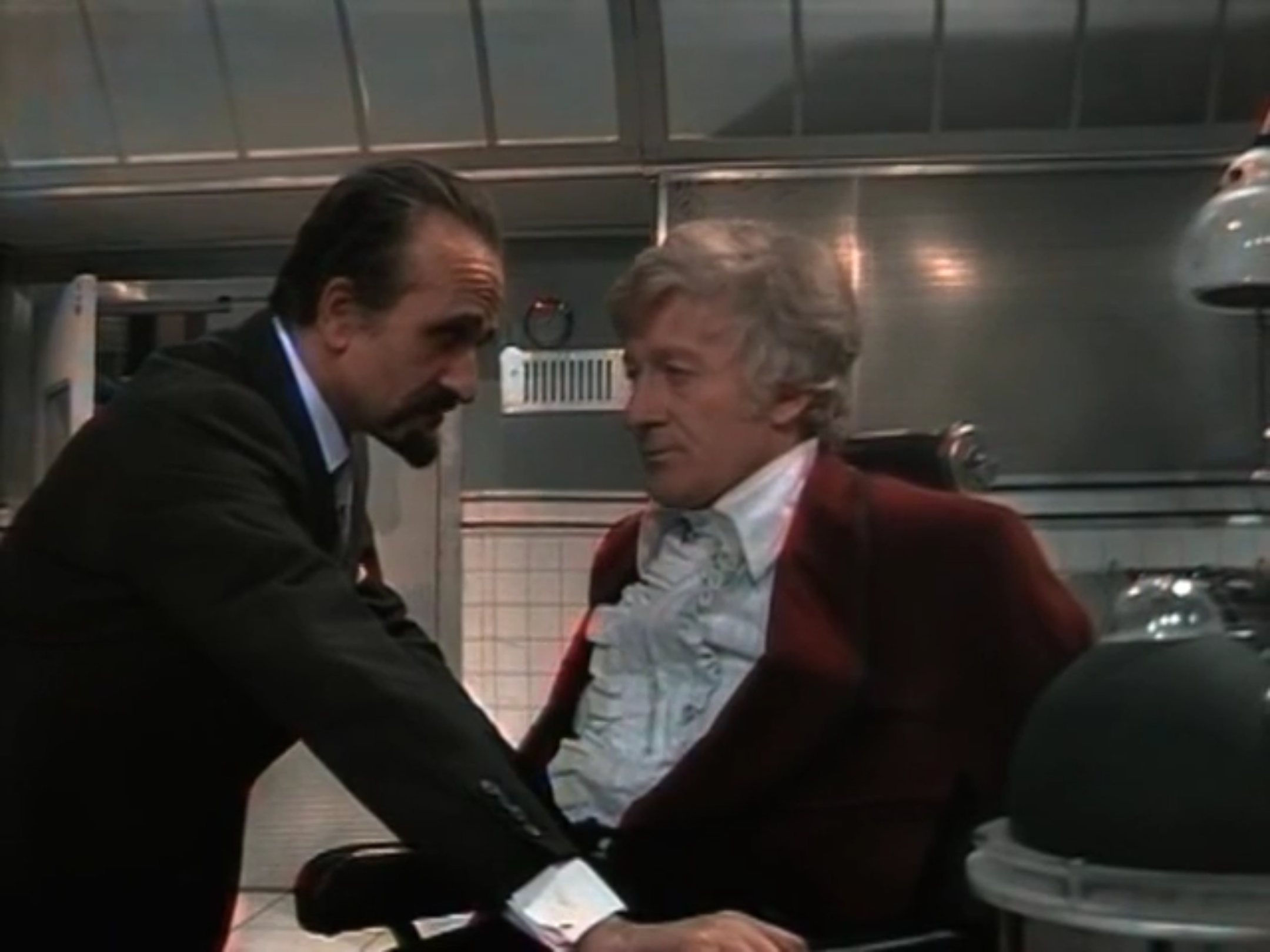
The Brigade Leader: The Brigadier in a fascist alternate timeline!

7 episodes. Written by: Don Houghton. Directed by: Douglas Camfield, Barry Letts (uncredited).  Directed by: Barry Letts.


THE PLOT

The "Inferno" is the name given to an ambitious drilling project overseen by Professor Stahlman (Olaf Pooley). He believes that piercing the Earth's core will release a gas that will provide a tremendous new energy source, and he is very close now to proving his theory.  All is not well, however. Stahlman is over-anxious to complete the drilling quickly, disregarding safety and ignoring dissenting voices. This has put him at odds with Sir Keith Gold (Christopher Benjamin), the executive director whose calls for caution have led the professor to regard him as an enemy.

As drilling nears completion, a green liquid begins to emerge from the #2 drill - a substance which, when touched, transforms men into Primords, murderous savages.  The Doctor should be on hand to find answers to these transformations. But an attempt to repair his TARDIS console has carried him sideways in time - to an alternate dimension where the UK is a fascist government, with fascist versions of all of the Doctor's associates. In this parallel dimension, the drilling is more advanced, with the problems leading the Doctor to a horrifying yet inescapable conclusion: If Stahlman's project is not stopped, it will mean the end of the world!


CHARACTERS

The Doctor: None of the Doctors exactly suffers fools gladly, but this is particularly true of the Third Doctor. He needles and belittles Stahlman from literally their first seconds on screen together. It is not a particularly constructive approach, as it makes it all the easier for the pig-headed Stahlman to dismiss him as a crank. It's actually rather refreshing, in that the Doctor's own faults act against him.

Pertwee continues to bring a refreshing intensity to his performance, commanding the viewer's attention at every turn. When he shouts that the Earth is "screaming out its rage," his delivery really sells it, making a line that could have been laughably melodramatic into something chilling. More than any other actor to play the role, he dominates the screen. Future seasons would only rarely see the same level of intensity from him; still, in his first run of stories, he has been consistently outstanding.

Brigadier Lethbridge-Stewart: In many ways, the Brigadier and the alternate-universe Brigade Leader are not far apart. Note the scene in Episode One in which the Doctor mocks the Brigadier's appearance in an old troop photo. The Brigadier (barely) tolerates the Doctor's good-natured mockery - but when Benton smiles along with him, the Brigadier wipes that smile instantly away by fixing him with a vicious glare. The harsher tendencies of the Brigade Leader are there... but kept in check by a basically good man, in a system where military authority has its limits.

They are not the same man, however. We have already seen how the Brigadier reacts when faced with his own death.  When he was caught unarmed, at the mercy of an enemy he had every reason to believe would shoot him, he responded with discipline and courage. The Brigade Leader reacts to the prospect of his own death with savagery and cowardice. Courtney is quite strong in both personas, but he clearly relishes the villainous turn he's allowed to give in the middle episodes.

Liz Shaw: Has become a real friend to the Doctor, and she feels concern when he disappears. When the Brigadier dismisses her worries by stating that he can take care of himself, she replies with a curt, "He's not indestructible, you know." The Doctor has shown enough of himself to her that she realizes that he is a great deal more vulnerable than he lets on. We also see how much faith he places in her judgment, notably in his interactions with her parallel counterpart. He dismisses the Brigade Leader as an oaf almost instantly. However, he never stops trying to reason with Section Leader Shaw, and eventually succeeds in convincing her of the truth of his story. Their relationship has been well-played all season, and it remains so here.  When the Doctor says, "I'll miss you, Liz," to her at the end, I could not help echoing the sentiment.


THE LAST 7-PART STORY

Inferno is the series' final 7-parter. It's easy enough to see why the 7-part format was abandoned. Outside of Seasons One and Seven, it was never a common format, and both script editor Terrance Dicks and producer Barry Letts were vocal in their dislike of it. I also suspect that Inferno's low ratings were partially due to audience fatigue after back-to-back 7-parters.  The stories were good - but that many long stories in a row, particularly screened at a pace of one episode per week, just became tiring for the viewers.

Still, the format has its advantages. One of these is obvious simply from reciting the titles of the series' 7-parters: The Daleks, Marco Polo, The Evil of the Daleks, Dr. Who & the Silurians, The Ambassadors of Death, Inferno. What do all of these wildly different stories have in common? They are all quite good!

I think one of Dicks' chief complaints about the format points to a potential virtue. Dicks has commented that with a 7-parter, there is a constant need to keep the story alive to maintain interest over such a long period.  This makes the job of the writer and script editor more difficult, but the resulting stories are much sharper for it.  The series' 7-parters rarely feel as padded as some of the 6-parters have, and I suspect much of that is because the writers knew that they couldn't get away with just stretching the story to fill the extra time.

Don't get me wrong: The 7-parter should never have been a dominant length, and three in one season was genuinely too many. But I think there should have been a place for the occasional 7-parter in later Who seasons, and their curtailment may have been more of a loss than a gain for the series.


THOUGHTS

It's an even question as to whether this or Dr. Who & the Silurians is the season's best story. I can see either argument. Silurians had a noticeable lull in its middle episodes, getting bogged down during the transition between set up and its climax. Inferno is much snappier in its pacing, retaining intensity throughout. Still, Silurians just pips it for me by being more substantial. Inferno is more immediately gripping while watching, but Silurians sticks more in my mind. Both are outstanding - among the very best serials in Doctor Who's enormously long history.

This is another superbly structured serial, a strength of the entire season. Everything within the story is established in the first episode. The parallel universe subplot? The Doctor makes his test run in Episode 1, running into that intriguing barrier that makes him determined to try again. Sir Keith preparing a complaint to the Ministry about Stahlman's instability? Well, we see Stahlman's obsessive stubbornness right at the start, along with his antagonistic attitude toward Sir Keith. The Primords provide the first cliffhanger. Even the harsh characterization of the Brigade Leader is given some groundwork in the "real" Brigadier, when he gives Benton that glare for laughing along with the Doctor at his expense.

I could pick a few nits if I wanted to. There's a continuity gaffe between Episodes Five and Seven: In Part Five, Sir Keith has persuaded the Minister to suspend drilling pending an inquiry. In Part Seven, he suddenly doesn't have the authority to stop the drilling. Um, oops? Also, the Primords do look a bit silly. Not bad by regular Who standards, but tacky by Season Seven standards.

Still, these issues aren't enough to make me lower my score. As with the rest of the season, Inferno is not only excellent Doctor Who - It's flat-out excellent television.


Rating: 10/10.

Previous Story: The Ambassadors of Death
Next Story: Terror of the Autons


Search Amazon.com for Doctor Who


Review Index

To receive new review updates, follow me:

On BlueSky:

On Threads: